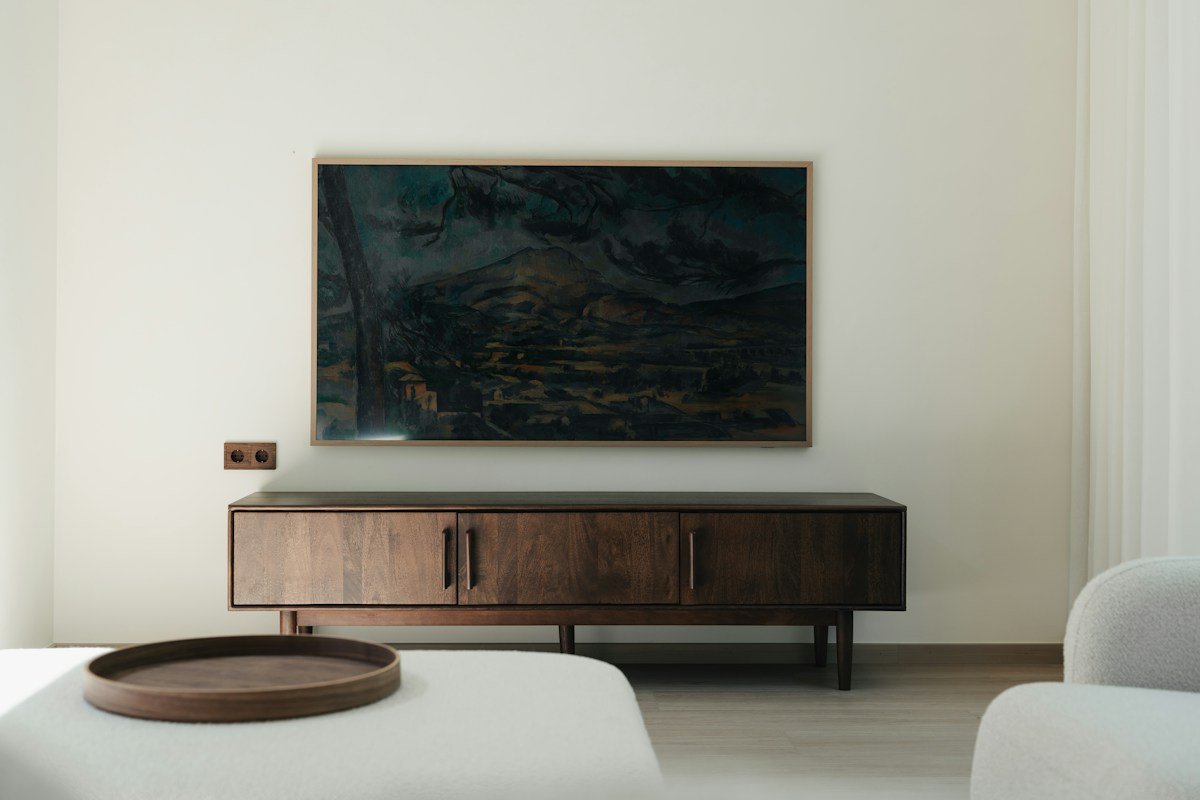
In the expansive pantheon of twentieth-century industrial and interior design, few furniture silhouettes command the enduring reverence, sculptural grace, and functional adaptability of the mid-century modern teak credenza. Originally conceived during the golden post-war era of Scandinavian modernism as a refined dining room sideboard for storing sterling flatware and porcelain china, the low-slung wooden credenza has effortlessly transitioned into the primary focal point of the contemporary living room. Today, it operates as the ultimate architectural anchor: grounding expansive wall planes, hiding sophisticated home entertainment technology, displaying curated artisanal vignettes, and infusing modern residences with organic warmth.
The timeless allure of mid-century case goods lies in their brilliant synthesis of humanistic warmth, minimalist restraint, and uncompromising cabinetmaking joinery. During the mid-twentieth century, visionary Danish, Swedish, and American designers rejected both the heavy, ornate, dust-gathering embellishments of Victorian cabinetry and the cold, unfeeling austerity of industrial tubular steel. Instead, they championed organic modernism: crafting low-profile, horizontal silhouettes that honored the biological beauty of natural wood grain while responding directly to the human body and ergonomic spatial flow. A vintage or heirloom-reproduction teak credenza does not merely occupy physical square footage; it establishes an aura of quiet confidence, artisanal dignity, and architectural serenity.
Yet bringing an authentic mid-century teak credenza or vintage sideboard into the twenty-first-century media environment introduces a fascinating design and engineering challenge. Mid-century cabinetmakers like Borge Mogensen, Arne Vodder, and Ib Kofod-Larsen designed their case goods to house linen tablecloths, silver platters, and vacuum-tube record players. They could never have envisioned seventy-five-inch OLED ultra-high-definition television panels, heat-spewing multi-channel audio-video receivers, sprawling tangle of HDMI and fiber-optic cables, gaming consoles, and streaming hubs. Harmonizing vintage wooden craftsmanship with high-performance modern consumer electronics requires thoughtful engineering: balancing thermal convective ventilation, structural shelf load calculations, concealed wire management raceways, and ergonomic screen heights without compromising the pristine historic integrity of the wood.
Executing an authentic, acoustically optimized, and structurally sound mid-century media installation requires synthesizing scientific wood moisture and density standards from the USDA Forest Products Laboratory, historical design scholarship preserved at The Metropolitan Museum of Art, professional electronic integration and thermal guidelines from the Custom Electronic Design and Installation Association, premium architectural case goods standards from the Architectural Woodwork Institute, and responsible forestry verification from the Forest Stewardship Council. This exhaustive masterclass guide details teak dendrology, vintage joinery hallmarks, thermal cabinet aerodynamics, wire routing engineering, vinyl record weight mechanics, surface vignette styling formulas, and natural oil preservation.
Teak Dendrology and Wood Chemistry: Tectona Grandis, Silica Content, and Natural Essential Oils
To understand why vintage teak furniture has survived sixty to seventy years in immaculate condition while lesser wooden pieces have warped, split, or succumbed to rot, one must examine the extraordinary botanical and chemical architecture of Burmese teak (Tectona grandis). Native to the tropical monsoon forests of Southeast Asia: particularly Myanmar, Thailand, and Indonesia: old-growth teak is a tropical hardwood species possessing unique physical characteristics that make it virtually indestructible.
The primary secret of teak’s legendary durability is its exceptionally high concentration of natural essential oils and resinous tectoquinones. Unlike temperate hardwoods like oak, maple, or cherry, which lose their volatile moisture and dry out into brittle wood fibers unless continually treated with topical coatings, teak produces dense natural resins that remain permanently locked within its cellular parenchyma cells. These hydrophobic oils provide lifelong internal lubrication, preventing the wood from drying, cracking, or becoming brittle over decades of indoor heating and air conditioning.
Furthermore, teak trees absorb substantial quantities of dissolved silicic acid from mineral-rich tropical soils, depositing microscopic crystals of silicon dioxide (silica) directly within the wood’s cell walls: silica content in old-growth teak frequently ranges from 0.5 to 1.5 percent of total wood mass. This microscopic mineral armor acts like built-in glass particles within the grain. It blunts woodcarving tools rapidly during manufacturing, but in everyday residential life, it gives teak remarkable natural resistance to surface scratching, gouging, and mechanical abrasion. Additionally, the silica and tectoquinones render teak 100 percent immune to fungal decay, dry rot, termites, and wood-boring powderpost beetles.
From an engineering standpoint, teak exhibits exceptional dimensional stability. Wood is a hygroscopic material that naturally swells across tangential and radial dimensions as ambient relative humidity rises and shrinks as humidity drops. The USDA Forest Products Laboratory rates teak as having one of the lowest volumetric shrinkage coefficients of any commercial timber: with a radial shrinkage of only 2.5 percent and tangential shrinkage of 5.8 percent from green to oven-dry state. This microscopic volumetric stability means that teak drawer boxes never stick in humid summer weather, sliding doors glide effortlessly across their wooden tracks year-round, and precision mitered case corners never open into unsightly seasonal cracks.
Aesthetically, old-growth teak undergoes a magical oxidation transformation. When first milled and cut, fresh teak often displays a mottled greenish-yellow or dull olive-brown hue with dark mineral streaks. However, when exposed to ambient oxygen and ultraviolet light over several months, photo-chemical oxidation reacts with the natural resins. The wood matures into a radiant, golden-honey or rich amber-brown patina with deep caramel undertones, fine dark grain lines, and an unmistakable silky, waxy luster that no synthetic stain or artificial laminate can replicate.
Danish Modern Case Good Lineage: The Master Cabinetmakers and Timeless Archetypes
The mid-century modern credenza did not emerge by historical accident. It was the crowning achievement of the Danish Modern design movement that flourished between 1940 and 1970, championed by the Cabinetmakers’ Guild of Copenhagen (Snedkerlauget) and visionary architect-designers who believed that daily utilitarian objects should elevate human well-being.
Borge Mogensen, known as the “designer of the common man,” revolutionized residential storage through scientific spatial studies. Mogensen spent years measuring everyday domestic objects: shirts, sweaters, plates, serving bowls, and books: developing standardized modular storage units with mathematical precision. His credenzas and sideboards (such as the famous Oresund series and Model 232) epitomize honest, functionalist purity. Featuring solid oak or beech interior drawer boxes wrapped in glowing teak carcasses, Mogensen’s designs relied on brass pull-rings, exposed finger joints, and perfectly proportioned drawers that celebrated clean geometric honesty without a single superfluous decorative flourish.
Arne Vodder, a brilliant protégé of Finn Juhl, introduced dynamic sculptural sensuality to teak case goods. Vodder’s legendary sideboards (produced primarily by the master workshop of P. Olsen Sibast) broke away from standard brass drawer pulls. Instead, Vodder hand-carved organic, recessed “lip” handles directly into the solid teak drawer fronts: continuous curved wooden troughs that fit the human fingers with silky, tactile perfection. Vodder’s iconic Model 29A sideboard featured reversible sliding doors lacquered in vibrant modernist colors (matte yellow, sky blue, charcoal gray, or white) on one side and natural bookmatched teak on the reverse, allowing homeowners to alter the visual personality of their dining room with a flick of the wrist.
Ib Kofod-Larsen took Danish craftsmanship to international acclaim through his celebrated Danish Design Collection for G-Plan and Faarup Mobelfabrik. Kofod-Larsen’s Model 66 and Model Faarup sideboards are revered for their ultra-clean, floating architectural profiles. Featuring elongated horizontal stretches: often spanning eight to nine feet: raised aloft on slender, tapered solid teak legs with organic sculptural stretchers, Kofod-Larsen designed cabinets that felt visually weightless despite offering enormous interior storage volume. The drawer pulls were sculpted as subtle, organic teak fins that cast soft, architectural shadows across the bookmatched grain.
Finn Juhl, Peter Hvidt, Orla Molgaard-Nielsen, and Hans Wegner further expanded the visual vocabulary of mid-century case goods: pioneering rolling tambour doors, woven cane door panels, and sculpted solid wood edge bandings that transformed utilitarian storage cabinets into museum-worthy sculptural masterpieces. Understanding this design pedigree ensures that when you curate a credenza for your living room, you are investing in a recognized chapter of twentieth-century art history.
Solid Teak vs Bookmatched Teak Veneers: Substrate Physics and Seasonal Expansion
A widespread misconception among amateur furniture collectors is the belief that “solid wood is always superior to veneer.” In the context of mid-century case goods, this assumption is fundamentally flawed. In reality, the finest vintage Danish master cabinetmakers deliberately and intentionally utilized wood veneers for large credenza carcasses, tops, and sliding doors, reserving solid teak strictly for legs, stretchers, edge bandings, and sculpted drawer pulls.
The rationale for this construction is rooted in solid lumber physics. A credenza top is a massive, unbroken horizontal plane typically measuring twenty to twenty-four inches deep and six to eight feet long. If this vast expanse were constructed from solid teak boards glued edge-to-edge, the natural cross-grain hygroscopic movement across seasonal humidity swings would exert tremendous mechanical force. During humid summers, a twenty-four-inch solid wooden slab can expand by a quarter of an inch or more. If restricted by internal drawer dividers and vertical partitions, this expansion creates intense internal stress, resulting in bowed tops, warped doors, and catastrophic splits down the center of the wood.
To eliminate this destructive seasonal movement, mid-century cabinetmakers perfected the art of architectural veneering over stable engineered substrates. In vintage Danish pieces, master craftspeople applied thick, knife-cut teak veneers (often 1.5 to 2.5 millimeters thick: vastly thicker than today’s paper-thin 0.5 millimeter commercial veneers) over multi-ply lumbercore or high-density furniture board. Lumbercore consists of solid strips of lightweight wood (like pine, fir, or basswood) glued side-by-side and sandwiched between cross-banded veneers, creating a substrate that is completely inert, exceptionally rigid, and immune to warping.
Veneering allowed master craftsmen to achieve breathtaking visual symmetry known as Bookmatching and Slipmatching. Craftsmen sliced consecutive veneer leaves from a single teak log and laid them out side-by-side like the open pages of a book. This technique mirrors the natural growth rings, cathedral arches, and grain swirls across the entire face of the credenza doors and drawers, creating a cohesive, flowing tapestry of grain that sweeps uninterrupted from the far left door to the far right drawer front. Surrounding these veneered panels, craftsmen applied thick, solid teak perimeter bullnose moldings (solid edge bandings) that could be rounded, sculpted, and repaired over decades of use.
Traditional Joinery Architecture: Dovetail Drawers, Tambour Doors, and Finger Joints
When authenticating a vintage credenza or evaluating a modern luxury reproduction, the joinery reveals the true structural integrity of the piece. True mid-century case goods were built according to rigorous cabinetmaking standards where mechanical friction and interlocking wooden geometry: not metal brackets or drywall screws: hold the furniture together.
Inspect the interior drawer construction. Exceptional credenzas feature English Dovetail or French Dovetail joints connecting the drawer fronts to the drawer sides. Hand-cut or precision-machined dovetails interlock trapezoidal wooden “pins” and “tails” that resist outward pulling forces permanently; even after being yanked open thousands of times with heavy loads, a dovetailed drawer front will never separate from its box. Drawer sides and backs in Danish pieces were traditionally crafted from solid European beech, quartersawn oak, or fragrant cedar, and the drawer bottoms were slotted into routed grooves with floating expansion room.
Tambour doors represent the technological and artisanal pinnacle of mid-century cabinetmaking. A tambour door is constructed by gluing dozens of narrow, precision-milled solid teak wooden slats onto a heavy, flexible woven canvas backing. The ends of the wooden slats ride inside precision-routed curved tracks in the top and bottom of the credenza carcass. When opened, the tambour door glides silently sideways and rolls smoothly around the internal corners, disappearing completely into hidden double-wall cavities behind the cabinet side panels. Tambour doors provide total access to interior shelves without swinging outward into conversational pathways, making them an ingenious design solution for compact modern living rooms.
Examine the leg and base assembly. Authentic mid-century credenzas almost never feature legs screwed directly into flat bottom panels with cheap metal angled plates. Instead, they sit atop an independent, solid teak trestle base or stretcher frame. This structural undercarriage consists of solid horizontal stretchers joined to tapered conical legs via mortise-and-tenon joints. The credenza carcass rests atop this reinforced stretcher grid, which distributes hundreds of pounds of downward cabinet weight evenly across the floor without sagging in the middle.
Contemporary Audio-Visual Integration: Thermal Convective Dynamics and CFM Airflow
Transforming a vintage or modern teak credenza into a twenty-first-century media console requires careful engineering to protect both expensive consumer electronics and the surrounding wooden cabinetry. Modern consumer electronics: particularly high-current multi-channel AV receivers, Class-A audio amplifiers, 4K Blu-ray players, and gaming consoles: generate substantial thermal energy. A modern gaming console or home theater receiver under load can dissipate between 200 and 450 watts of heat, reaching internal operating temperatures of 140 to 160 degrees Fahrenheit.
If electronic components are enclosed inside a sealed wooden credenza with solid doors and an unventilated solid wooden back, the trapped heat creates an oven-like micro-climate. High temperatures cause electronic microprocessors to throttle performance, trigger automatic safety shutdowns, and drastically shorten the operational lifespan of electrolytic capacitors. Furthermore, excessive trapped heat dries out the natural oils in the surrounding teak wood, causing internal veneer delamination, glue failure, and finish checking.
Preserving equipment and cabinetry requires establishing calculated Natural Convective Airflow and Forced-Air CFM Ventilation. Natural convective ventilation relies on the chimney effect: as air inside the cabinet warms, it becomes less dense and naturally rises. To harness this airflow, the cabinet requires intake openings in the bottom floor and exhaust openings at the top of the rear back panel. Cold ambient room air is drawn upward through the floor vents, sweeps across the heat sinks of the AV receiver, and vents harmlessly out through the rear upper exhaust slots.
For high-heat home theater systems housing multiple power amplifiers or gaming consoles, passive convection is insufficient; active, ultra-quiet cooling fans must be specified. Modern low-voltage (12-volt DC) cabinet cooling systems (such as those manufactured by AC Infinity) feature dual or triple 120mm fans engineered with dual-ball bearings and pulse-width modulation (PWM) speed controllers. These fans operate at whisper-quiet sound levels (below 18 to 22 dBA: virtually inaudible in a living room) while moving 50 to 100 Cubic Feet per Minute (CFM) of air. The fans are linked to intelligent thermal probes that automatically modulate fan speed based on internal cabinet temperature, ensuring that the credenza interior remains safely below 85 to 90 degrees Fahrenheit.
Concealed Cable Routing and Wire Management Raceways
Nothing destroys the serene elegance of a mid-century living room faster than a chaotic nest of tangled black power cables, HDMI cords, Ethernet cables, and bulky power bricks hanging down beneath a leggy console. Because mid-century credenzas are elevated on slender, tapered legs, the open space beneath the cabinet exposes every stray wire to direct view.
Executing an invisible wire management schema begins with discrete cable pass-throughs. If working with a valuable vintage collector’s piece, cutting into original solid wood or backboards should be strictly avoided. Instead, look for vintage pieces with removable back masonite panels, or pass thin cables through existing shelf gaps. When commissioning a custom reproduction or modern console, specify two-inch circular grommet holes routed through internal shelf dividers and the rear backboard, lined with solid turned brass or black anodized aluminum grommet collars.
Inside the cabinet, mount a heavy-duty, surge-protected power distribution strip to the underside of a shelf or onto the interior rear wall using vibration-dampening screws. Plugging all equipment into this single internal power hub means that only one single master power cord needs to exit the credenza and reach the wall outlet. Encase this master cable inside a braided, color-matched fabric wire sleeve (such as woven heather gray or tan) that runs tightly down the back of a rear leg, secured with clear silicone clips. Inside the cabinet compartments, bundle signal cables (HDMI, optical, RCA) and power cords separately: crossing them at 90-degree right angles when necessary to eliminate electromagnetic interference (EMI) and 60-cycle audio hum.
Television Scale, Viewing Angles, and Ergonomic Horizon Standards
Mounting or resting a modern flat-panel television above a mid-century credenza requires adhering to strict ergonomic optical standards established by the Society of Motion Picture and Television Engineers (SMPTE) and THX. The most prevalent decorating error is mounting the television far too high: creating an awkward “sports bar” angle that forces viewers to crane their necks upward, resulting in severe cervical spine fatigue after a two-hour movie.
The fundamental ergonomic rule of comfortable television viewing is the eye-level horizon line. When seated comfortably on a standard sofa (where seated human eye height is typically thirty-eight to forty-two inches above the finished floor), the center of the television screen should align directly with your seated eye level, or sit within a maximum upward tilt angle of fifteen degrees. Mid-century credenzas are ergonomically ideal for this purpose: their low-profile heights (typically twenty-four to thirty inches high) place tabletop-mounted televisions at the exact optical sweet spot for seated relaxation.
Scale and proportion are equally paramount. Aesthetically, a television screen should never be wider than the credenza supporting it. Placing a huge screen that cantilevers past the edges of a console creates a visually top-heavy, precarious composition that fractures the balance of the room. As an architectural rule of thumb, the credenza should be at least ten to sixteen inches wider than the television screen: leaving five to eight inches of breathing space on either side. For example, a sixty-five-inch television (which measures approximately fifty-seven inches in physical width) should be paired with a credenza measuring at least sixty-six to seventy-two inches in length.
Vinyl Record Storage Physics and Structural Shelf Load Calculations
The vinyl renaissance has restored the mid-century credenza to its original cultural calling as a dedicated analog music listening station. Placing a high-fidelity turntable on top of a credenza while storing a collection of 12-inch vinyl records inside is a glorious tactile ritual. However, vinyl records introduce immense structural dead weight that can easily destroy unreinforced cabinetry.
Vinyl records are extraordinarily heavy. A standard twelve-inch vinyl LP in its cardboard sleeve weighs between seven and eight ounces; a dense collection of seventy to eighty records packed tightly across one linear foot of shelf space weighs thirty-five to forty pounds! A four-foot credenza shelf loaded end-to-end with vinyl records supports over one hundred and fifty pounds of concentrated downward force.
Wood shelves under heavy continuous loads are subject to wood creep: long-term irreversible structural sag governed by the classic Beam Deflection Formula. To prevent unsightly, sagging shelves, architects utilize the Sagulator engineering formula to calculate shelf thickness and unsupported span limits. A standard 3/4-inch veneered particle board shelf will visibly sag and fracture under eighty pounds of vinyl if the span exceeds twenty-four inches. For safe vinyl record storage, interior shelves must be crafted from minimum 1-inch thick solid hardwood, reinforced with a front solid-hardwood stiffener lip, or supported by an intermediate vertical wooden divider every eighteen to twenty-two inches.
Furthermore, turntable vibration isolation is essential for pristine audio playback. Turntable phono cartridges are sensitive electromechanical seismographs that translate microscopic groove modulations into electrical sound. If footsteps on bouncy floorboards transfer vibrations up through credenza legs into the turntable platter, the needle will skip, producing boomy acoustic feedback. To eliminate vibration, place the turntable on a dedicated isolation platform: such as a heavy one-inch slab of honed black granite or end-grain maple resting on high-density Sorbothane hemispherical elastomer feet. Sorbothane absorbs up to 94 percent of kinetic vibration, decoupling the turntable from living room footfalls.
Surface Vignette Styling Formulas: Asymmetry, Negative Space, and Tactile Contrasts
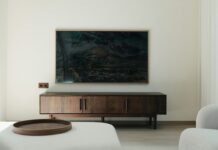
When the television is mounted on the wall above the credenza or when the credenza functions purely as an accent piece, its wide wooden top plane provides a magnificent canvas for curating sophisticated interior design vignettes. Styling a mid-century credenza requires embracing organic Scandinavian asymmetry and deliberate negative space: avoiding cluttered, symmetrical arrangements that feel stiff and commercial.
The premier styling strategy is the Rule of Thirds and the Dynamic Pyramid Formula. Mentally divide the horizontal surface of the credenza into three equal sections. Anchor one third (typically the left or right side) with an element of significant vertical height: such as an artisanal matte ceramic vase holding architectural dried branches, a sculptural brass table lamp with a natural linen drum shade, or a tall framed art print leaning casually against the wall.
In the adjacent section, balance the tall vertical anchor with a medium-height, sculptural grouping: such as a curated stack of three cloth-bound hardcover design monographs topped with a brass magnifying glass or a rough piece of natural mineral quartz. In the third section, introduce a low, tactile horizontal vessel: such as a shallow hand-carved walnut catchall tray, an antique travertine marble bowl, or a small grouping of fragrant beeswax candles.
The secret that separates amateur decorating from professional curation is Negative Space. Never cover more than sixty to sixty-five percent of the credenza top plane with objects. Leave generous, uninterrupted expanses of glowing golden teak grain open to the light. The natural grain of the wood is itself an exquisite work of fine art; allowing the grain to breathe highlights its rich cathedral arches and prevents the living room from feeling overcrowded.
Wood Preservation, Daily Maintenance, and Restoration Protocols
Authentic vintage teak furniture was rarely finished with thick, plasticized polyurethane or high-gloss synthetic varnishes. Instead, mid-century Danish workshops utilized penetrating oil finishes: primarily raw or boiled linseed oil blends, tung oil, and natural beeswax. Penetrating oil finishes soak deep into the wood pores, enhancing the grain without creating a hard plastic film on the surface, preserving the silky, natural tactile warmth of the timber.
Daily maintenance is delightfully simple. Dust the credenza weekly using a dry, ultra-soft microfiber cloth or an ostrich feather duster, wiping strictly in the direction of the wood grain. Never use commercial aerosol dusting sprays or silicone-laden furniture polishes; these products deposit synthetic silicone films that trap dust, cloud the grain, and prevent the wood from absorbing nourishing natural oils.
Every six to twelve months, replenish the wood’s natural moisture by applying a coat of high-grade Danish Oil or specialized Teak Oil (such as boiled linseed oil blended with mineral spirits and mild drying resins). Apply the oil sparingly with a clean cotton rag or lint-free painter’s pad, working along the grain. Allow the oil to penetrate the pores for fifteen to twenty minutes, then vigorously wipe the surface completely dry with a fresh cotton towel until no tacky residue remains. This replenishing ritual restores deep luster, camouflages microscopic surface scuffs, and enhances the golden-amber patina.
For accidental moisture rings (the dreaded white cloudy ring left by a cold drink glass placed without a coaster), take immediate action. White rings indicate trapped moisture within the top wax or oil layer (if the ring is black, moisture has penetrated deep into the raw tannin fibers, requiring professional stripping). Trapped white moisture can often be removed by applying a small dab of non-gel white toothpaste mixed with baking soda onto a soft cloth, rubbing gently along the grain for thirty seconds, and buffing dry with teak oil. Alternatively, placing a dry cotton tea towel over the white ring and applying a warm (no steam!) clothes iron for five-second intervals will evaporate the trapped moisture cleanly.
Acoustic Decoupling and Center Channel Speaker Dynamics
In high-fidelity home theater configurations, the center channel speaker or compact audio soundbar is tasked with reproducing over seventy percent of all movie dialogue. Placing a powerful speaker directly onto the flat wooden surface of a credenza introduces mechanical acoustic coupling. When dialogue frequencies (ranging from 100 Hz to 4 kHz) pump through speaker drivers, mechanical energy transfers directly into the hollow credenza carcass.
This kinetic vibration turns the wooden credenza into a giant acoustic resonator: generating muddy, boomy dialogue and audible vibrations across drawer hardware. To ensure pristine vocal clarity and protect vintage wood from micro-scratching, audio engineers prescribe acoustic decoupling pads. Placing high-density closed-cell polyurethane isolation wedges (such as Auralex MoPADs or Sorbothane isolation pucks) beneath speaker corners completely breaks the mechanical transmission path, isolating sound vibrations within the speaker cabinet and letting spoken dialogue ring out with crystalline accuracy.
Solid Brass Hardware Metallurgy and Non-Invasive Patina Care
The hardware adorning authentic mid-century Scandinavian case goods: precision pull-rings, flush cup handles, keyhole escutcheons, and slender leg ferrules (sabots): was almost universally cast or stamped from solid brass. Unlike modern zinc pot-metal plated with shiny yellow coatings, genuine solid brass is an alloy of copper and zinc that naturally reacts with ambient oxygen and atmospheric humidity over decades.
This natural oxidation creates a dignified, deep golden-brown or warm olive patina that represents the visual hallmark of vintage provenance. A tragic mistake made by enthusiastic amateur restorers is attacking vintage brass hardware with aggressive liquid brass polishes (such as Brasso) while still attached to the wood. Liquid metal polishes contain harsh ammonia and petroleum abrasives that seep into the surrounding unfinished teak grain, leaving permanent chalky white residues and chemically blackening wood fibers.
If brass hardware requires gentle brightening, always remove the screws and detach each piece completely from the wood carcass before cleaning. Wash the hardware in warm water mixed with mild conservation-grade detergent, buff lightly with micro-fine jeweler’s rouge cloth to lift heavy tarnish while preserving the antique character, and allow pieces to air-dry completely before reinstalling with hand-driven brass screws.
Comprehensive Mid-Century Case Goods and Media Storage Matrix
To assist collectors, homeowners, and interior designers in evaluating the primary mid-century case goods typologies, the following engineering and stylistic matrix compares the four dominant credenza architectures across essential practical parameters. Reviewing these verified benchmarks ensures your furniture investment perfectly matches your living room storage needs and equipment footprint.
Analyzing these parameters demonstrates that while open consoles provide rapid equipment ventilation, classic sliding and tambour doors offer superior acoustic concealment, dust protection, and sculptural elegance. Incorporating thermal fan kits bridges the gap between vintage charm and modern high-heat electronics.
| Credenza / Console Typology | Door Mechanism | AV Heat Dissipation | Vinyl Storage Suitability | Cable Management Ease | Ideal Living Room Layout |
|---|---|---|---|---|---|
| Classic Danish Low-Profile Sideboard | Sliding wood doors / drawers | Moderate (Requires rear slots) | Exceptional (13-inch vertical bay) | Moderate (Requires rear grommets) | Formal living rooms, audiophile music rooms |
| Sculptural Tambour Door Credenza | Roll-away slatted tambour | High (Doors roll out of sight) | Very High (Reinforced lower base) | Moderate to High | Compact urban apartments, tight traffic paths |
| Woven Cane / Rattan Panel Console | Bifold or hinged cane doors | Maximum (Passive mesh airflow) | Moderate (Requires solid shelves) | High (IR remotes pass through cane) | Warm organic modern, high-heat AV setups |
| Wall-Mounted Floating Teak Console | Drop-down acoustic flaps | High (Open bottom convective vents) | Low to Moderate (Weight restricted) | Maximum (In-wall stud conduit) | Minimalist spaces, robotic vacuum homes |
Before committing to your living room arrangement, review these essential answers to frequently asked technical and styling questions to ensure your mid-century case good delivers seamless daily enjoyment.
Frequently Asked Questions About Mid-Century Teak Credenzas
How can you tell if a mid-century credenza is authentic vintage or modern reproduction?
Authentic vintage Scandinavian credenzas typically feature maker stamps or foil labels from Danish Furniture Makers Control (Dansk Mobelkontrol), high-grade multi-ply lumbercore substrates wrapped in thick 2mm knife-cut veneers, hand-cut dovetail drawer joinery crafted from solid beech or oak, and solid teak sculpted pulls. Modern mass-produced reproductions often rely on thin paper veneers over light MDF, cam-lock fasteners, stapled drawer boxes, and synthetic plastic finishes.
Can you safely place a large 75-inch TV on a vintage teak credenza?
Yes, provided the credenza has a reinforced center leg or stretcher base. While old-growth teak is remarkably strong, a four-point leg base without a center support leg can sag slightly in the middle under the sustained fifty to seventy-pound concentrated weight of an oversized television. Alternatively, mounting the television securely to wall studs four to six inches above the credenza relieves all weight from the furniture.
Do infrared (IR) remote controls work through solid teak doors?
No, standard infrared remote signals cannot penetrate solid wood doors. To control components hidden behind closed doors, install an inexpensive IR repeater kit (which places a tiny receiver bead on the outside that repeats the signal to blasters inside), use equipment governed by RF (Radio Frequency) or Wi-Fi smartphone controls, or choose consoles with woven cane door panels that allow IR signals to pass through naturally.
How do you prevent audio equipment from overheating inside a credenza?
Ensure a minimum of two to three inches of clear airspace above and beside each component, cut intake ventilation slots in the cabinet floor and exhaust slots in the upper rear panel, and install an ultra-quiet 12-volt thermal-activated cooling fan (such as an AC Infinity fan system) to continuously evacuate hot air when temperatures exceed 85 degrees Fahrenheit.
What is the difference between teak oil and Danish oil?
Both are penetrating oil finishes formulated from mixtures of linseed oil, tung oil, mineral spirits, and mild drying resins. Products labeled “teak oil” often contain specialized ultraviolet inhibitors and slightly lower viscosity to penetrate dense oily hardwoods, whereas “Danish oil” tends to build a slightly higher polymer sheen on open-grained woods. Both are safe and effective for conditioning mid-century case goods.
Why did Danish modern designers use veneers instead of 100 percent solid wood?
Danish master cabinetmakers utilized thick veneers over stable lumbercore specifically to prevent the severe seasonal wood warping, expansion, and cracking that inevitably plagues massive expanses of solid timber. Veneering also allowed craftsmen to execute magnificent bookmatched grain symmetries that are physically impossible with solid boards.
How much weight in vinyl records can a credenza shelf safely hold?
A standard 3/4-inch shelf can hold approximately thirty to forty pounds without sagging if the span is thirty inches or less. Because a full shelf of vinyl records weighs thirty-five to forty pounds per linear foot, shelves must be crafted from 1-inch thick hardwood, reinforced with a front stiffener cleat, or supported by an intermediate vertical divider every eighteen to twenty inches.
Can water rings be removed from vintage teak finishes?
Yes. White water rings signify trapped moisture in the surface oil and wax layer. They can often be removed by gently buffing along the grain with a 1:1 mixture of non-gel white toothpaste and baking soda, followed by replenishing teak oil. Deep black water stains indicate chemical reaction with wood tannins and require professional restorative sanding.
How often should a teak credenza be re-oiled?
In standard indoor residential environments, teak credenzas should be conditioned with penetrating oil every six to twelve months. Homes with intense winter forced-air heating or direct sun exposure may benefit from light quarterly applications to maintain the wood’s deep amber luster.
Conclusion: Curating Timeless Mid-Century Functionality
The mid-century modern teak credenza stands as an enduring testament to the power of thoughtful, human-centered design. In an era dominated by disposable, flat-pack consumer goods, an authentic teak case piece offers an irreplaceable grounding presence: connecting daily living room rituals to the organic majesty of tropical hardwood forests and the golden age of Scandinavian cabinetmaking. By engineering smart thermal ventilation, mastering cable management, respecting vinyl weight mechanics, and honoring the natural grain with regular oil conditioning, you create an inspiring media sanctuary that will serve your household with grace for generations to come.