In contemporary residential interior architecture, the living room is defined by sweeping open sightlines, expansive drywall spans, and generous seating arrangements. At the center of this spatial drama sits the sectional sofa: a commanding, multi-cushioned upholstered anchor that establishes the conversational geometry of the great room. Yet, as majestic and inviting as an oversized modular sectional is, it introduces a monumental decorating challenge directly behind it: a vast, intimidating expanse of blank vertical drywall that can easily leave the entire room feeling cavernous, unfinished, and unanchored.
For decades, homeowners struggled to resolve this visual void. Common decorating missteps include the timid “gallery wall of miniatures”: a cluttered cluster of small, mismatched eight-by-ten-inch picture frames that look like visual noise floating above a massive ten-foot sectional; or the dreaded “undersized focal point,” where a single thirty-inch print floats lost and lonely like an unmoored island across an ocean of drywall. Rather than bringing cohesion, these undersized treatments shatter visual scale, making grand sectional sofas appear bloated and disproportionately heavy.
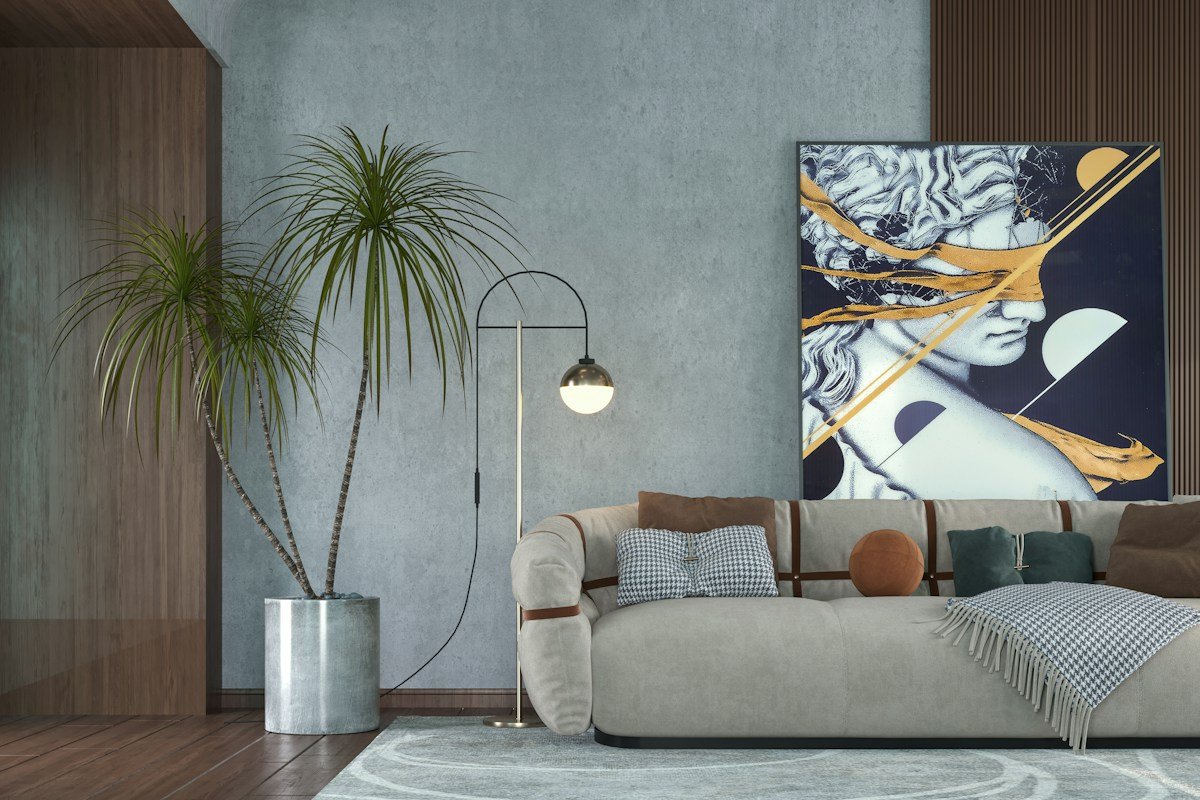
The definitive, architecturally authoritative antidote to this spatial dilemma is the oversized abstract canvas painting. A monumental original or fine-art abstract canvas spanning sixty, seventy-two, or even eighty-four inches in width possesses singular artistic gravity. It bridges the vertical expanse between the back cushion plane and the ceiling line, introduces emotive chromatic energy, absorbs ambient acoustic reflections, and establishes an authoritative visual dialogue with the surrounding architecture. A masterfully scaled abstract painting does not merely decorate a wall; it transforms an ordinary family living room into a sophisticated, museum-caliber sanctuary.
Executing an authentic, museum-grade art installation requires synthesizing conservation and spatial display standards from the National Gallery of Art, historical curation principles from The Museum of Modern Art, residential spatial balance guidelines from the American Society of Interior Designers, textile and tension conservation directives from the American Institute for Conservation, stretcher bar joinery treatises from the Tate Museum, and professional architectural lighting principles from the National Gallery. This comprehensive engineering and curation manual delivers an exhaustive analysis of proportional mathematics, optical eye-level horizon lines, sectional asymmetry balances, stretcher frame mechanics, heavy-duty French cleat anchoring, museum lighting angles, and chromatic color harmonies.
Proportional Geometry and Spatial Mathematics: The Two-Thirds to Three-Quarters Rule
The primary governing principle of successful wall art placement is mathematical scale. Human visual perception naturally craves balance, proportion, and visual weight. When the brain scans an interior environment, it evaluates objects not in isolation, but in relation to adjacent planes, volumes, and anchor furnishings. An artwork that violates natural proportional ratios triggers subconscious visual discomfort, making a room feel awkward and disjointed.
The golden architectural benchmark for hanging art above any seated furniture anchor is the Two-Thirds to Three-Quarters Width Formula. To calculate the ideal width for your oversized canvas, measure the overall horizontal width of the sectional sofa back directly beneath the wall (or the primary seating run). Your artwork should occupy approximately sixty-six to seventy-five percent of that total width.
Consider a practical architectural scenario: an expansive contemporary sectional sofa featuring an eight-foot (ninety-six-inch) primary back run. Applying the two-thirds rule (96 multiplied by 0.66) yields a minimum art width of approximately sixty-three inches; applying the three-quarters rule (96 multiplied by 0.75) yields an upper width boundary of seventy-two inches. Therefore, a monumental sixty-by-forty-inch or seventy-two-by-forty-eight-inch canvas establishes flawless visual equilibrium. The artwork is wide enough to command authority and anchor the furniture mass, yet leaves twelve to sixteen inches of breathing room on either end so the composition does not feel cramped or visually claustrophobic.
Installing a canvas that matches the exact one-hundred-percent width of the sofa creates a rigid, boxy, and oppressive composition that overwhelms the room. Conversely, hanging an artwork that measures less than fifty percent of the sofa width creates the weak “postage stamp” effect: the massive furniture visually swallows the diminutive painting, rendering it visually insignificant.
Center-of-Vision Optics and Ergonomic Hanging Heights: The 57 to 60-Inch Horizon Rule
The second most prevalent error in residential art display is hanging artwork far too high on the wall. In residential homes with nine, ten, or twelve-foot ceilings, homeowners frequently make the mistake of centering artwork vertically on the wall itself: placing the canvas near the ceiling line like a billboard. This awkward placement severs the visual connection between the artwork and the furniture beneath it, forcing occupants to crane their necks upward uncomfortably.
Professional art galleries, major metropolitan museums, and architectural curators adhere strictly to the 57 to 60-Inch Centerline Rule. This standard is based on human optical ergonomics: the average seated and standing adult human eye-level horizon sits precisely fifty-seven to sixty inches above the finished floor plane. In gallery curation, the center point of the artwork: not the top or bottom of the frame: is aligned directly along this fifty-eight-inch horizon line.
However, when hanging an oversized canvas above a high-back or low-slung sectional sofa, the eye-level rule must be harmonized with the Furniture Clearance Gap Rule. The bottom edge of the canvas must hover approximately six to ten inches above the top edge of the sofa back cushions. An eight-inch clearance is widely regarded by interior designers as the optical sweet spot.
This critical eight-inch gap serves vital functional and visual purposes. Aesthetically, it creates a deliberate, cohesive gravitational bond between the painting and the sofa, unifying them into a singular, grounded architectural composition rather than two detached floating objects. Functionally, an eight to ten-inch gap prevents occupants from bumping their heads against the canvas when leaning back, tossing throw pillows, or stretching on the sofa, protecting both human comfort and expensive artwork from accidental mechanical impacts.
Sectional Sofa Typologies and Asymmetrical Visual Balances: L-Shapes vs Chaise Lounges
Unlike traditional linear three-seater sofas that present a simple, symmetrical rectangular footprint, modern sectional sofas come in dynamic, asymmetrical configurations. Understanding how different sectional shapes influence visual weight is essential for positioning an oversized canvas with harmonious balance.
L-Shaped Sectionals with an Extended Corner Return present an asymmetrical visual mass. One arm of the sectional is typically longer than the other, and the deep corner unit draws significant visual weight toward one side of the room. When hanging an oversized canvas on the main wall behind the long run, novice decorators often center the painting along the entire wall plane, ignoring the furniture below. This creates severe visual tension because the painting’s center line fails to align with the furniture’s functional center.
The professional curation rule for L-shaped sectionals is to center the oversized canvas over the primary seating run rather than the full length of the wall. Measure from the outer edge of the sofa arm to the interior junction of the corner wedge, find the exact midpoint of that primary conversational run, and align the vertical centerline of your canvas directly over that point. This anchors the painting directly to the human conversational zone.
Sectionals with a Floating Chaise Lounge present another distinct compositional opportunity. A chaise lounge features an open, low-profile horizontal silhouette with no backrest on its terminal end. Centering a massive canvas over the entire footprint (including the chaise) can leave the art feeling off-center relative to the back cushions. To restore perfect equilibrium, center the canvas over the backrest portion of the sectional, and balance the visual weight of the extended chaise lounge on the opposite side using a tall, architectural floor lamp (such as an arched brass or matte black task lamp) or a large potted indoor tree (such as a Ficus lyrata or mature Olive tree) that introduces vertical greenery to balance the composition.
U-Shaped Sectionals feature dual returns flanking a central main sofa run. Because U-shaped sectionals are inherently symmetrical and monumental in footprint, they demand equally monumental, centered art treatments. An oversized horizontal canvas spanning seventy-two to eighty-four inches, perfectly centered between the two returns, creates an awe-inspiring, symmetrical gallery pavilion that anchors the entire living room.
Single Statement Canvas vs Multi-Panel Diptychs and Triptychs: Dynamic Negative Space
When curating monumental art for an expansive sectional wall, homeowners must decide between a single monolithic statement canvas or a multi-panel composition: specifically a Diptych (two panels) or a Triptych (three panels). Both approaches offer extraordinary architectural advantages when proportioned correctly.
A Single Oversized Canvas represents the ultimate expression of bold, uncluttered minimalism. A single monolithic painting (such as a seventy-two-by-forty-eight-inch original) creates an arresting, unbroken visual focal point that calms busy open-concept living rooms. There are zero interior seams, gaps, or frame divisions to distract the eye. A single statement piece radiates confidence, visual tranquility, and museum authority, making it the premier choice for dramatic abstract compositions featuring sweeping color fields, deep atmospheric gradients, or bold gestural brushwork.
A Diptych or Triptych provides exceptional versatility, rhythm, and architectural modulation. Composed of two or three vertically oriented panels hung side-by-side (such as three thirty-by-sixty-inch canvases), a multi-panel installation allows an abstract composition to unfold sequentially across the wall plane. The vertical breaks introduce rhythm and linear cadence, breaking up expansive horizontal drywall without overwhelming the room.
The critical secret to executing a successful diptych or triptych is spacing discipline. When hanging multiple panels above a sectional, the physical gap between adjacent canvases must be tightly controlled: maintaining strictly two to three inches (fifty to seventy-five millimeters) between frames. If the gap is too wide (five or six inches), the human brain stops perceiving the panels as a unified work of art and starts viewing them as disconnected, floating fragments. Furthermore, the combined total width of all panels PLUS the internal gaps must satisfy the golden two-thirds to three-quarters width rule relative to the sectional sofa beneath.
Canvas Substrate Science and Joinery Mechanics: Linen, Stretcher Bars, and Cross-Bracing
Behind every magnificent abstract painting lies the structural engineering of its physical support. An oversized canvas is a large, tensioned architectural membrane subjected to environmental humidity fluctuations and gravitational stresses. Far too many budget commercial art prints utilize cheap softwood frames that warp, twist, and sag within twelve months, ruining the visual presentation.
The gold standard of canvas textiles is 100 percent Heavyweight Belgian Flax Linen (measuring 12 to 15 ounces per square yard). Unlike short-staple cotton duck canvas which stretches easily and responds dramatically to ambient humidity swings, natural flax linen consists of long-staple bast fibers rich in natural cellulose and pectin. Belgian linen boasts superior tensile strength, a tight organic weave texture, and exceptional dimensional stability. When properly sized with rabbit-skin glue or archival synthetic sizing and primed with multiple layers of titanium-dioxide gesso, linen provides an archival, puncture-resistant foundation that preserves vibrant paint pigments for centuries.
The internal wooden skeleton supporting the canvas is the Stretcher Frame. For oversized artworks spanning sixty inches or wider, standard thin one-inch stretcher bars are completely inadequate; under the continuous tension of tightly stretched linen, thin bars will bow inward, creating unsightly puckering and diagonal corner ripples. Oversized canvases strictly require Heavy-Duty Gallery Stretcher Bars crafted from kiln-dried, quartersawn white pine, basswood, or tulipwood, measuring a minimum depth of 1.5 to 2.5 inches (thirty-eight to sixty-four millimeters).
Furthermore, high-grade gallery stretcher frames incorporate traditional mortise-and-tenon mitered corner joints fitted with hardwood corner keys (stretcher wedges). These adjustable wedges allow conservators and homeowners to gently tap the corners with a mallet years later to expand the frame microscopically, instantly restoring crisp drum-tight surface tension if the canvas ever experiences minor environmental sagging. For spans exceeding forty-eight inches, the frame must incorporate internal mortised wooden cross-braces (vertical and horizontal center stretchers) to prevent lateral racking and diagonal frame twisting.
Floating Frames vs Gallery-Wrapped Edges: Shadow Gaps and Hardwood Profiles
How an oversized canvas terminates at its perimeter dictates whether it reads as a casual artist studio study or a bespoke, museum-worthy architectural installation. The two primary presentation methods are Gallery-Wrapped Edges and Custom Floating Frames.
A Gallery-Wrapped Canvas features canvas fabric stretched seamlessly around the thick 1.5 to 2.5-inch sides of the heavy-duty stretcher bars, stapled exclusively on the reverse side of the wood. The painted composition or a complementary solid color extends continuously around all four edges. A gallery wrap presents a clean, rimless, and contemporary silhouette that feels organic and visually weightless. It is particularly effective in ultra-minimalist, industrial modern, or Scandinavian living rooms where visible frame mouldings might introduce unnecessary visual clutter.
The Floating Frame (Floater Frame) represents the absolute pinnacle of contemporary fine-art presentation. In a floater frame, the stretched canvas is mounted securely from behind into an L-shaped wooden moulding, leaving a deliberate, visible 1/4-inch to 3/8-inch shadow gap between the edge of the canvas and the interior lip of the frame. The painting appears to float weightlessly inside the frame without touching the border.
This shadow gap creates profound architectural depth: casting subtle natural shadows that separate the artwork from the surrounding room while defining a crisp, tailored boundary. High-end floating frames are milled from solid North American hardwoods: such as rift-sawn White Oak with a matte clear finish, solid American Black Walnut with rich natural grain, or solid Maple with a satin carbon-black lacquer. A floating frame adds substantial structural stiffness to oversized canvases, prevents corner edge damage during vacuuming and living room traffic, and elevates the entire composition to fine-art gallery status.
Heavy-Duty Wall Anchoring Engineering: French Cleats, Z-Bars, and Shear Load Safety
An oversized framed canvas spanning six to seven feet in width is a substantial physical object. When constructed from heavy linen, solid hardwood stretcher bars, internal cross-braces, and a solid oak floating frame, a large piece can easily weigh between twenty-five and fifty-five pounds. Securing this massive artwork safely above a living room sectional where family members, children, and pets sit daily is an issue of critical physical safety.
Relying on traditional picture wire, small angled nails, or adhesive picture strips for an oversized canvas is a dangerous installation failure waiting to happen. Picture wire places intense lateral tension on the side stretcher bars, causing the frame to bow inward over time; moreover, a single wire point allows the artwork to tilt askew whenever a door slams, someone bumps the sofa, or heavy trucks rumble past the house.
The definitive engineering solution for mounting heavy oversized wall art is the Architectural French Cleat or Heavy-Duty Aluminum Z-Bar System. A French cleat consists of two interlocking brackets with matching 45-degree complementary bevels. One cleat is mounted horizontally and level across the wall, while the mating cleat is fastened securely to the upper rear stretcher bar of the artwork.
When the canvas is lifted onto the wall, the two beveled cleats slide together and interlock mechanically under downward gravitational force. A French cleat distributes the artwork’s downward shear load continuously across forty to sixty inches of wall span, eliminating localized point stresses. The wall cleat must be fastened into at least two solid wooden wall studs using heavy-duty structural wood screws; where studs are unavailable, industrial toggle bolts (such as Toggler SnapSkates rated for over 150 pounds of shear load in drywall) must be utilized. A French cleat ensures the oversized canvas hangs permanently, perfectly flush against the drywall, completely immune to shifting or falling, even during minor seismic tremors or accidental bumps.
Gallery Lighting Schemas: Color Rendering Index (CRI 95+) and 30-Degree Beam Angles
Even the most breathtaking original abstract painting will appear dull, lifeless, and visually flat if it is illuminated poorly. Standard residential ceiling lighting: such as center flush-mount fixtures or diffuse recessed downlights: washes out delicate brushwork, creates harsh specular glare, and distorts subtle paint pigments.
Illuminating an oversized canvas like a world-class art gallery requires understanding the Golden 30-Degree Angle Rule of architectural lighting. To eliminate blinding surface glare while accentuating rich painterly impasto textures, ceiling-mounted adjustable accent lights (such as recessed directional gimbals or minimalist architectural track spots) must be positioned so that the light beam strikes the center of the canvas at a thirty-degree angle relative to the vertical wall plane.
If the light fixture is placed too close to the wall (an angle smaller than thirty degrees), it creates harsh, downward skimming shadows that exaggerate every minor canvas ripple and leave the lower half of the painting in darkness. If the light fixture is mounted too far into the room (an angle greater than forty-five degrees), the light bounces off the glossy varnish directly into the eyes of seated viewers on the sectional sofa, creating blinding reflective glare that obscures the artwork entirely.
The spectral quality of the light source is equally vital. Always specify LED luminaires boasting a Color Rendering Index (CRI) of 95 or higher, paired with a high R9 saturated red rating (> 85). Standard cheap LEDs have poor color rendering (CRI 80), which mutes warm ochres, rich crimsons, and subtle earth tones, casting an artificial, sickly greenish-blue cast across the artwork. A high-CRI 2700K to 3000K warm-white LED accurately renders every microscopic pigment nuance exactly as the artist intended in the studio.
Color Theory and Chromatic Harmony: Dialogue Between Canvas, Sectional, and Decor
The final aesthetic frontier in selecting an oversized abstract canvas is establishing a sophisticated chromatic dialogue with the surrounding room. Abstract art offers total emotional and formal freedom; it does not depict recognizable objects, relying instead on pure color, form, texture, and visual tension to evoke human mood.
The most sophisticated interior design strategy is avoiding the juvenile “matching” trap. Never attempt to match the dominant color of your abstract canvas exactly to the color of your sectional sofa fabric. If you have a navy blue velvet sectional, hanging a predominantly navy blue painting creates a monotonous, muddy blob of blue that suffocates the living space. Instead, utilize Color Theory and Chromatic Contrast.
If your sectional sofa is an expansive neutral: such as warm oatmeal linen, crisp cream performance twill, or charcoal gray: the oversized canvas should introduce dynamic complementary or split-complementary chromatic accents. For example, above a warm cream sectional, an abstract composition featuring deep burnt sienna, raw umber, warm ochre, and accents of oxidized teal or Prussian blue creates stunning visual drama and organic warmth.
Ensure that the painting shares a subtle Bridge Color with at least two or three smaller decorative elements in the living room: such as the terracotta tone in a handwoven area rug, the brass patina of a floor lamp, or the olive hue of an artisanal ceramic bowl on the coffee table. This subtle chromatic echo weaves the artwork organically into the fabric of the room, making it feel curated, cohesive, and deeply intentional.
Conservation Physics: UV Defense, Varnishing, and Indoor Environmental Controls
An oversized fine-art canvas represents a significant financial and emotional investment that should endure for decades without fading, yellowing, or cracking. Protecting the artwork from environmental degradation requires basic conservation discipline.
Ultraviolet (UV) radiation is the foremost enemy of fine art pigments. High-energy UV rays break the molecular bonds of organic paint dyes, causing brilliant cadmiums, crimsons, and delicate blues to fade irreversibly. Never hang an oversized canvas directly opposite unshaded, south-facing windows where direct sunlight washes over the painted surface. Treat windows with UV-blocking architectural window films (filtering 99 percent of UV rays), or ensure the painting has been sealed with a high-grade removable archival varnish containing UV light stabilizers (such as Golden MSA Varnish or Gamvar).
Ambient indoor relative humidity must be maintained between 40 and 55 percent, with temperatures between 65 and 75 degrees Fahrenheit. Severe winter dryness caused by forced-air furnaces desiccates natural linen canvas bast fibers, making paint layers brittle and prone to micro-cracking; excessive summer humidity causes canvas fibers to absorb moisture, sag, and risk mildew growth. By stabilizing your home’s indoor climate, your statement artwork will remain taut, radiant, and pristine for generations.
Seismic Restraints and Anti-Tip Mechanical Security for Overhead Art
When suspending a heavy forty to fifty-pound framed artwork directly above a primary family seating zone, calculating vertical and lateral dynamic forces is an essential safety responsibility. In regions prone to seismic tremors or in homes with energetic young children and large dogs who regularly launch themselves onto sectional sofas, standard gravity-hung cleats can experience upward vertical bounce. If a severe mechanical vibration lifts the canvas even half an inch upward, the beveled cleat can disengage, dropping the heavy frame onto the sofa below.
To eliminate this catastrophic risk, professional art installers install Seismic Security Locking Cleats and Bottom T-Head Anchors. High-performance aluminum French cleat systems feature a bottom locking channel fitted with spring-loaded stainless steel locking pins or thumbscrews. Once the upper cleat interlocks, the installer tightens a set screw through the bottom bracket lip, physically locking the artwork to the wall so it cannot be lifted upward without a screwdriver.
Alternatively, installers use Museum T-Screw Security Brackets at the bottom edge of the frame. A T-screw is anchored into a drywall anchor or wall stud, while an slotted steel bracket is screwed to the back of the bottom wooden frame stretcher. Using a specialized long-reach security wrench, the installer turns the T-screw ninety degrees inside the slotted bracket, mechanically locking the bottom of the canvas against the wall. This three-point anchoring system ensures absolute seismic stability, theft prevention, and total protection against child or pet impacts.
Acoustic Diffusion Coefficients and Reverberation Time Dampening (RT60)
Modern great rooms featuring open-concept layouts, soaring cathedral ceilings, and hard flooring surfaces: such as polished porcelain tile or engineered hardwood: frequently suffer from poor acoustic ergonomics. Sound waves generated by home theater soundbars, television dialogue, and family conversations bounce relentlessly between parallel drywall planes, creating annoying flutter echo and extended Reverberation Time (RT60 exceeding 1.2 to 1.5 seconds).
An oversized stretched canvas operates as a covert architectural acoustic absorber. Unlike rigid plaster walls, hard glass mirrors, or metallic decorative panels that reflect 100 percent of incident acoustic energy, natural stretched linen canvas behaves as a low-tension acoustic diaphragm. Incident sound waves strike the flexible linen surface, causing the fabric to flex microscopically and converting acoustic sound pressure into harmless microscopic friction heat.
To elevate an oversized canvas into a high-performance acoustic broadband absorber, interior designers specify hollow-backed acoustic treatment. The empty 2-inch to 2.5-inch void between the canvas fabric and the back of the heavy-duty stretcher frame is filled with rigid, formaldehyde-free mineral wool (such as Roxul Rockboard 40) or high-density recycled polyester acoustic battings (measuring 2-inch thickness). This turns a seventy-two-by-forty-eight-inch statement canvas into an authoritative acoustic panel boasting a Noise Reduction Coefficient (NRC) of 0.75 to 0.85, dramatically dampening harsh mid-frequency speech reflections and creating a quiet, intimate conversational oasis around the sectional sofa.
Archival Cleaning Protocols, Microfiber Mechanics, and Soot Mitigation
Preserving the pristine optical luminosity and pigment purity of an oversized abstract painting requires disciplined, non-invasive maintenance protocols. In active living rooms, airborne household dust, pet dander, lint, and aerosolized cooking oils from adjacent open kitchens naturally settle onto the top horizontal surfaces of frames and the textured impasto ridges of canvas surfaces.
Never spray liquid glass cleaners, multi-surface chemical sprays, or aerosol furniture polishes directly onto an acrylic or oil painting. Liquid chemicals contain surfactants, ammonia, and alcohol that dissolve fragile paint films, soften acrylic emulsions, and leave milky white haze streaks across varnishes. Instead, perform monthly dry dusting using a conservation-grade Goat-Hair Radiator Brush or an ultra-soft electrostatic ostrich feather duster, gently brushing in the direction of the paint strokes from the top of the canvas downward.
For fine dust on unvarnished acrylic paint surfaces, use a vulcanized dry-cleaning soot sponge (chemical sponge). Gently press and lift the natural rubber sponge across the canvas surface without aggressive scrubbing; the porous vulcanized rubber lifts embedded soot and dust particles into its matrix without leaving any chemical residue behind. Additionally, placing a high-efficiency particulate air (HEPA) purifier in adjacent open-concept kitchen zones prevents aerosolized frying oils and fireplace soot from reaching and bonding to your living room canvas art.
Acrylic Impasto Textures, Heavy Gel Mediums, and Surface Topography
Modern abstract expressionism relies heavily on physical surface topography. Artists utilize palette knives, trowels, and heavy gel mediums to apply thick peaks and ridges of high-viscosity acrylic paint: a technique known historically as impasto. When applied to an oversized canvas spanning six to seven feet, impasto creates an engaging three-dimensional tactile landscape that transforms flat paint into a sculptural relief.
This surface relief plays a profound role in residential living room ambiance. When directional gallery spotlighting strikes the textured canvas at a thirty-degree angle, the raised ridges of paint cast microscopic shadows across the surface. As the ambient daylight in the living room shifts from crisp morning sun to warm evening lamplight, the shadows lengthen and evolve, giving the painting a kinetic, living presence that changes throughout the day.
From a structural conservation perspective, heavy impasto adds substantial physical weight and introduces tension across the canvas weave. To prevent thick impasto peaks from cracking or delaminating over decades of seasonal humidity shifts, professional artists blend acrylic pigments with 100 percent acrylic copolymer emulsion gels (such as Golden Extra Heavy Gel or Modeling Paste). High-grade acrylic polymers retain permanent microscopic flexibility after curing, allowing the thick paint layers to expand and contract harmoniously with the underlying linen without cracking.
Comprehensive Abstract Art and Sectional Wall Placement Matrix
To assist homeowners, collectors, and interior designers in planning the perfect art installation above an expansive living room sectional, the following architectural and engineering matrix compares the four primary canvas presentation formats across essential spatial, structural, and aesthetic parameters. Reviewing these verified guidelines ensures your selection delivers flawless proportional harmony and structural safety.
Analyzing these parameters demonstrates that while single oversized canvases deliver maximum minimalist impact, multi-panel diptychs and triptychs offer superior installation flexibility across massive wall expanses. Selecting high-CRI directional lighting and heavy-duty French cleat anchoring ensures museum-caliber presentation and absolute physical security.
| Canvas Presentation Format | Ideal Sectional Width Ratio | Weight & Mounting System | Lighting Requirement | Acoustic Dampening Impact | Best Architectural Setting |
|---|---|---|---|---|---|
| Monolithic Oversized Canvas (Single) | Strictly 66% to 75% of sofa width | 25 to 50 lbs (Continuous French Cleat) | Dual 30-degree gimbal spots (CRI 95+) | High (Absorbs mid-frequency echoes) | Minimalist great rooms, high ceilings |
| Vertical Diptych (Two Panels) | 70% to 75% total width (2-3″ gap) | 15 to 25 lbs per panel (Dual Z-Bars) | Individual dedicated spot per panel | Moderate to High | L-shaped sectionals, tall vertical walls |
| Horizontal Triptych (Three Panels) | 75% of sofa width (2″ gaps between) | 12 to 20 lbs per panel (Triple cleats) | Linear architectural multi-head track | Very High (Broad surface diffusion) | Extra-long 12-foot sectionals, lofts |
| Solid Hardwood Floating Frame | 66% to 75% (Adds 1.5″ to perimeter) | 35 to 55 lbs (Stud-anchored cleat) | High-CRI accent spots with shadow gap | High (Dense hardwood edge reflection) | Transitional, mid-century luxury homes |
Before driving a single screw into your drywall, review these essential answers to frequently asked technical and aesthetic questions to ensure your art installation proceeds with precision and confidence.
Frequently Asked Questions About Canvas Art Placement
How high should an oversized canvas hang above a sectional sofa?
The bottom edge of an oversized canvas should hang approximately six to ten inches above the top edge of the sectional sofa back cushions. An eight-inch gap is widely considered the ideal optical distance: it keeps the artwork closely connected to the furniture below while preventing occupants from bumping their heads when leaning back.
What size canvas is needed for a 10-foot sectional sofa?
For a ten-foot (120-inch) sectional, apply the two-thirds to three-quarters rule. Two-thirds of 120 inches is eighty inches; three-quarters is ninety inches. Therefore, an oversized canvas measuring seventy-two to eighty-four inches wide (or a diptych/triptych spanning that combined width) provides perfect proportional balance.
Should I center the art over the entire wall or over the sectional?
You should almost always center the artwork directly over the sectional sofa (or its primary seating run), not over the entire expanse of the wall. Centering art on an empty wall while the furniture sits off to one side creates severe visual tension and disconnects the painting from the living space.
What is a French cleat and why is it needed for heavy canvas art?
A French cleat is an interlocking bracket system with two matching 45-degree beveled edges. One cleat is mounted to the wall studs and the other to the back of the artwork. It distributes the weight of a heavy thirty to fifty-pound canvas evenly across the wall, prevents the art from shifting or tilting, and ensures the canvas hangs completely flush against the drywall.
What is the difference between a gallery wrap and a floating frame?
A gallery-wrapped canvas has the canvas fabric stretched and stapled around the back of thick wooden stretcher bars with no external frame. A floating frame mounts the stretched canvas inside a wooden moulding with a deliberate 1/4-inch shadow gap between the canvas edge and the frame, making the artwork appear to float weightlessly inside.
How do I prevent glare on an oversized abstract painting?
Position ceiling accent lights so the beam strikes the center of the canvas at a 30-degree angle relative to the wall. This angle highlights the painting’s rich texture and brushwork while deflecting reflective glare safely down toward the floor away from seated viewers.
Can an oversized canvas help reduce echo in a large living room?
Yes. Stretched canvas acts as a natural acoustic diaphragm. Unlike hard drywall or glass mirrors that reflect 100 percent of sound waves, natural linen canvas stretched over hollow wooden frames absorbs and diffuses mid-frequency sound waves, helping dampen flutter echo and softening the acoustics in open-concept living rooms.
What is the 57 to 60-inch eye-level rule in art hanging?
The 57 to 60-inch rule is a museum standard where the vertical center point of the artwork is aligned precisely fifty-seven to sixty inches above the finished floor, matching the average human eye-level horizon line. When hanging above a sofa, this rule is adjusted slightly to maintain the mandatory six to ten-inch gap above the back cushions.
What type of light bulb is best for illuminating abstract paintings?
Select warm-white (2700K to 3000K) LED bulbs with a Color Rendering Index (CRI) of 95 or higher and a high R9 saturated red rating. High-CRI lighting reveals the true, vibrant depth of artist pigments without creating dull, muddy, or greenish color distortions.
Conclusion: Transforming Blank Living Room Drywall into an Evocative Gallery Sanctuary
An expansive living room wall above a sectional sofa should never be viewed as an intimidating decorating void; it is a blank architectural canvas awaiting emotive expression and visual balance. By honoring mathematical proportions, respecting the 57 to 60-inch eye-level horizon, embracing the sculptural elegance of floating frames, and engineering secure French cleat anchors, you elevate your living space far beyond ordinary decorating. An oversized abstract canvas painting breathes soul, color, and quiet dignity into your home: creating an inspiring gallery sanctuary where family and friends gather in enduring comfort and beauty.