
In the contemporary landscape of distributed knowledge work, clear communication and sustained mental focus represent the currency of professional achievement. Video conference calls, high-stakes client presentations, podcasts, and collaborative virtual meetings have transformed the home office into a broadcast studio. Yet, many professionals conduct business in untreated domestic spaces plagued by acoustic chaos: harsh slap echoes, hollow boxy reverberations, street traffic rumble, and family chatter filtering through hollow-core doors. Straining to comprehend muddled audio through headphones drains cognitive stamina, while speaking into an echo chamber makes even the most articulate executive sound unprofessional.
Acoustic architectural design bridges the gap between commercial recording studio physics and warm residential interior elegance. Achieving pristine sound within a residential office does not require plastering walls with ugly black foam egg crates or transforming your spare bedroom into an industrial bunker. Modern acoustic solutions: such as precision-milled slatted timber panels backed with recycled acoustic felt, custom fabric-wrapped fiberglass baffles, sculptural natural cork tiles, and preserved moss installations: introduce rich tactile beauty while systematically absorbing destructive sound reflections. By engineering the acoustic dynamics of your room, you create a serene, cocoon-like environment that fosters deep cognitive flow and delivers broadcast-quality vocal clarity.
Designing an acoustically optimized remote workspace demands understanding wave mechanics, decibel decay curves, and certified architectural testing standards. Drawing upon acoustic benchmarks established by the Acoustical Society of America, laboratory testing methodologies from ASTM International, environmental noise control research curated by the Institute of Noise Control Engineering, guidelines from the Noise Pollution Clearinghouse, and architectural acoustic directives from the Whole Building Design Guide, this manual provides an authoritative guide to soundproofing and acoustic treatment.
Throughout the comprehensive technical sections that follow, we unpack every dimension of residential acoustic treatment and architectural noise control. You will explore sound absorption coefficients (NRC) versus sound transmission isolation (STC), timber batten diffusion physics, corner bass trapping, reflection point mapping, ceiling cloud suspension, perimeter door sealing, secondary window acoustic glazing, biophilic moss acoustics, and HVAC mechanical silencing. Whether you are battling external urban sirens or seeking pristine microphone reproduction for executive webinars, this master guide provides field-tested blueprints to achieve world-class acoustic comfort in your home workspace.
Acoustic Physics 101: Sound Absorption (NRC) vs Sound Isolation (STC)
The single most pervasive misconception among homeowners addressing office noise is confusing sound absorption with soundproofing. Homeowners frequently purchase thin acoustic foam tiles, glue them to drywall, and express surprise when they can still hear a vacuum cleaner running down the hallway or street traffic outside their window. These two architectural challenges govern entirely different physical phenomena: acoustic treatment alters how sound behaves inside a room, whereas soundproofing prevents sound from entering or leaving a room.
Sound absorption is quantified by the Noise Reduction Coefficient (NRC), a standardized metric ranging from 0.00 to 1.00 established by ASTM C423 laboratory tests. An NRC rating of 0.00 indicates perfect acoustic reflection (such as bare concrete or float glass), where zero percent of sound energy is absorbed and one hundred percent bounces back into the room as an echo. Conversely, an NRC rating of 1.00 indicates perfect sound absorption, where one hundred percent of incident sound energy is absorbed, dissipating into heat energy within porous material fibers. Porous treatments: like acoustic felt, mineral wool, and dense fiberglass: target internal reflections, reducing reverberation time (RT60) to eliminate slap echo and make speech crisp and articulate.
Sound isolation, in contrast, is quantified by Sound Transmission Class (STC), an integer rating governed by ASTM E90 tests that measures how effectively an architectural partition attenuates airborne sound transmission between spaces. A standard residential drywall partition (half-inch drywall over two-by-four timber studs with no internal insulation) provides an STC rating of approximately 33 to 35: loud conversation filters through effortlessly. Achieving an STC rating of 50 or higher: where loud yelling or television audio becomes completely inaudible: requires adding heavy physical mass (such as double layers of five-eighths-inch drywall or mass-loaded vinyl), resilient isolation channels that decouple drywall from framing, and dense mineral wool insulation inside wall cavities.
Reverberation time (RT60) represents the critical parameter for vocal intelligibility. RT60 measures the time in seconds required for sound energy inside a room to decay by sixty decibels after the sound source ceases. In a bare residential room with hardwood floors and parallel gypsum walls, RT60 frequently exceeds 1.2 seconds, resulting in muddy, hollow audio that confuses webcam microphones and fatigue listener ears. An optimal home office acoustic profile requires an RT60 between 0.3 and 0.5 seconds, providing a dry, intimate acoustic environment where speech sounds authoritative and natural.
Frequency band absorption characteristics dictate material selection. Human vocal speech fundamentals operate primarily in the mid-frequency range between 250 Hz and 4,000 Hz, with vocal sibilance and clarity harmonics extending upward to 8,000 Hz. Thin one-inch open-cell foam tiles only absorb high frequencies above 2,000 Hz, leaving mid-frequency vocal energy and low-frequency HVAC rumble completely untreated, creating an uncomfortably boomy, muffled room. Professional treatment requires broad-spectrum absorbers measuring two to four inches in thickness that absorb evenly across all vocal octaves.
Understanding the inverse square law and wave propagation in enclosed residential spaces clarifies why hard surfaces compound vocal mud. When a human voice produces sound waves, spherical wave fronts travel outwards until they hit rigid drywall boundaries. Without adequate absorption, these waves reflect repeatedly, interfering destructively with direct sound waves arriving at the microphone diaphragm. This phenomenon creates comb filtering, where specific frequencies cancel out while other frequencies are unnaturally boosted. Calibrating your room with balanced absorption and diffusion stops comb filtering, ensuring your natural vocal timbre is captured with fidelity and warmth.
Acoustic Wood Slat Paneling: Architectural Joinery and Sound Diffusion
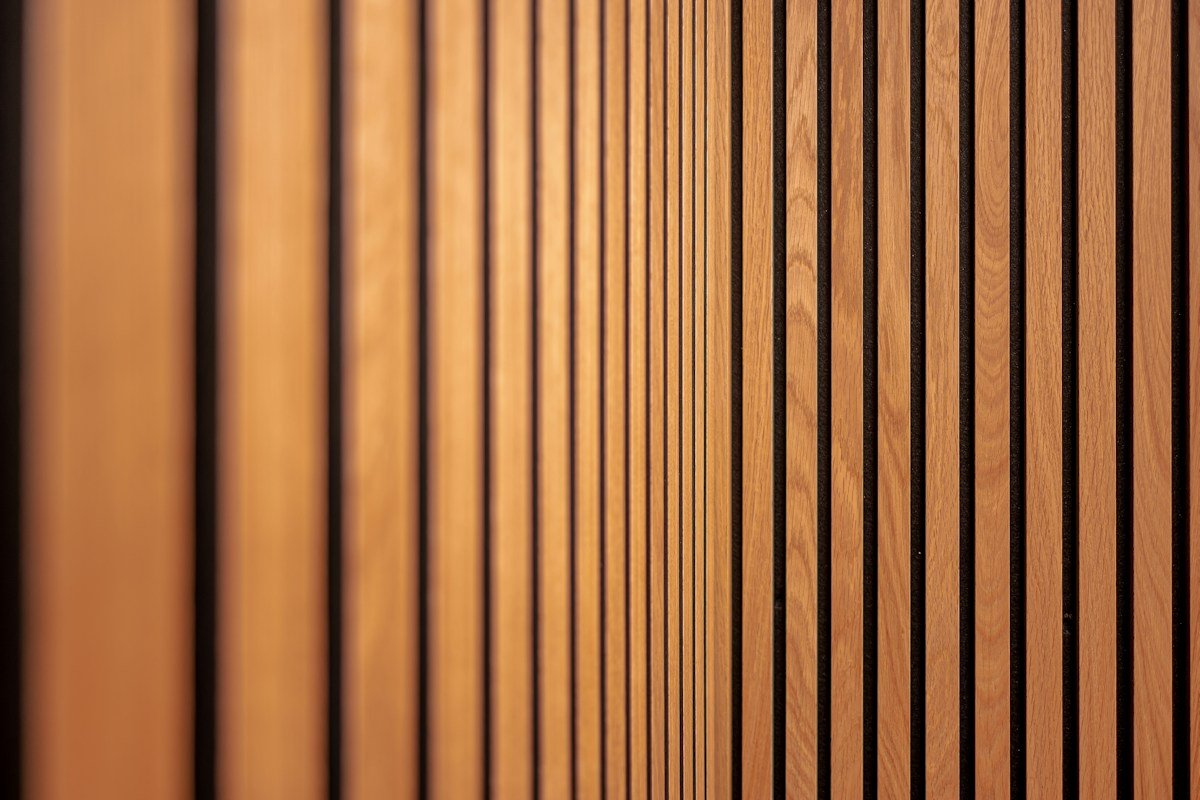
Acoustic timber slat paneling has emerged as the definitive benchmark of luxury residential interior design. Featuring slender vertical wooden battens mounted over dark acoustic felt, these architectural panels deliver an extraordinary union of Scandinavian minimalism and high-performance sound absorption. Rather than concealing acoustic treatments like clinical studio panels, slatted timber transforms ordinary walls into stunning textural focal points that elevate overall room elegance.
The acoustic physics of slatted wood panels relies on a sophisticated hybrid mechanism: sound diffusion combined with resonant cavity absorption. When sound waves hit the wooden slats, a portion of the high-frequency sound energy strikes the front wood faces and scatters in multiple directions, diffusing reflections without deadening the room completely. Simultaneously, sound waves penetrate the gaps between slats and enter the dense acoustic felt backing, where sound energy is converted into microscopic friction and heat within entangled polyester fibers.
Dimensional specifications govern the acoustic absorption curve of slat panels. Commercial panels typically feature real wood veneer (white oak, walnut, or ash) wrapped around high-density fiberboard (MDF) slats measuring twenty-seven millimeters in width by twelve millimeters in depth, spaced thirteen millimeters apart on center. Beneath the slats lies a nine-millimeter acoustic felt backing manufactured from recycled PET plastic bottles. Mounted directly to drywall with screws or adhesive, this system achieves an NRC rating of approximately 0.55 to 0.65, absorbing up to sixty-five percent of vocal reflections.
Maximizing low-frequency absorption requires introducing an engineered rear air cavity. Screwing slatted panels directly to a flat drywall surface limits performance on lower frequencies. By first installing horizontal wooden furring strips (measuring one to two inches in depth) against the wall, packing the interstitial gaps with dense rockwool mineral wool battens, and mounting the slatted panels over the furring, you create a deep resonant air cavity. This advanced installation method elevates the system’s NRC rating to an astonishing 0.85 to 0.95, effectively taming low-frequency male vocal resonance and environmental traffic hum.
Installation choreography can be customized for full-wall accent installations or partial floating backdrops. For remote workers seeking an impressive video conference backdrop, installing slatted panels along the wall directly behind the office chair creates an architectural broadcast set. Installing matching perimeter LED channels along the vertical edges of the panels casts soft grazing light across the timber slats, highlighting wood grain textures and creating captivating three-dimensional shadow lines.
Maintenance and longevity of timber slat systems represent another distinct advantage over synthetic materials. Natural wood veneers treated with matte polyurethane or hardwax oils resist dust accumulation and can be easily cleaned using a soft microfiber brush or vacuum attachment with a bristle head. Unlike traditional fabric panels that may absorb ambient domestic odors or stain from accidental spills, slatted timber maintains its pristine showroom appearance for decades, making it a permanent architectural upgrade that enhances overall home resale value.
Fabric-Wrapped Fiberglass Panels vs Open-Cell Acoustic Foam
While slatted timber panels provide striking visual texture, fabric-wrapped acoustic panels remain the uncompromised gold standard for high-efficiency sound absorption in professional broadcasting and recording environments. Understanding the material differences between commercial fiberglass panels and budget acoustic foam prevents costly mistakes and fire hazards.
Commercial fabric-wrapped panels utilize rigid, semi-rigid high-density fiberglass boards (typically Owens Corning 703 or 705) with densities ranging from three to six pounds per cubic foot. The microscopic glass fiber structure provides optimal tortuosity: a labyrinth of tiny air passages that forces sound waves to expend maximum kinetic energy as they pass through. A two-inch-thick fabric-wrapped fiberglass panel achieves an outstanding NRC rating of 1.00 across critical speech frequencies, absorbing one hundred percent of incident voice reflections.
In stark contrast, consumer open-cell polyurethane foam tiles deliver vastly inferior acoustic performance. Thin foam tiles possess low physical density (barely one to 1.5 pounds per cubic foot), which allows mid- and low-frequency sound waves to pass straight through and bounce off the drywall behind. Over time, polyurethane foam oxidizes, shedding fine dust particles into indoor air, turning brittle, and discoloring into an unsightly yellow. Furthermore, many cheap imported foam tiles lack certified flame retardants, posing severe residential fire hazards.
Fire safety compliance is a critical consideration for permanent wall treatments. Commercial fiberglass panels wrapped in acoustically transparent fabrics (such as Guilford of Maine acoustic textiles) carry rigorous ASTM E84 Class A fire ratings: the highest level of flame spread and smoke development resistance. This ensures that wall treatments comply fully with residential building codes and will not accelerate fire spread in the event of an electrical emergency.
Fabric wrapping allows limitless aesthetic customization that integrates with interior decor. Rather than looking like a utilitarian studio, fabric-wrapped panels can be upholstered in elegant woven wools, textured bouclés, or natural linens in colors matching your room’s palette. Installing panels with beveled, mitered edges and hidden impaling clips creates clean, frameless geometric art groupings that soften room aesthetics while delivering surgical sound control.
When selecting upholstery fabrics for DIY or custom panel fabrication, breathability is the essential physical requirement. If you cannot easily breathe through a fabric sample when holding it tightly against your mouth, sound waves cannot penetrate it either; instead, sound will reflect off the fabric surface before reaching the absorbent fiberglass core. Avoid tightly woven synthetic pleathers, vinyls, or coated upholstery textiles, choosing instead open-weave natural linens, pure cotton duck, or commercially rated acoustically transparent polyester textiles.
Corner Bass Traps and Low-Frequency Standing Wave Management
One of the most neglected acoustic challenges in residential home offices is the buildup of low-frequency sound energy in room corners. Low-frequency sound waves, ranging from 40 Hz to 200 Hz, possess long physical wavelengths: a 100 Hz wave measures over eleven feet in length. When these long waves travel across a small residential office, they reflect between opposing boundaries and collide with themselves, creating standing waves and severe room modes.
Room modes create dramatic acoustic inconsistencies throughout the space. In certain spots in the room, low frequencies cancel each other out, leaving the sound hollow and thin. In other spots: particularly along perimeter walls and in room corners: low frequencies combine constructively, creating massive bass peaks that exceed baseline levels by fifteen to twenty decibels. If your desk or microphone is situated near one of these bass buildup zones, male vocalists and deep voices take on an uncomfortably boomy, muddy resonance that overwhelms webcam audio processors.
Trihedral corners: where two walls meet the ceiling or floor: act as acoustic funnels where room modes reach maximum acoustic pressure. Because sound pressure is highest at room boundaries and corners, positioning acoustic absorption directly in room corners yields the highest efficiency per square foot of material. Standard two-inch flat wall panels are completely ineffective at absorbing long low-frequency wavelengths; conquering bass requires dedicated corner bass traps with significant physical depth.
Porous corner bass traps utilize triangular wedges of dense semi-rigid mineral wool or fiberglass stacked floor-to-ceiling in the corners. By filling the corner cavity with porous insulation measuring twelve to seventeen inches in depth, the trap absorbs sound energy at the quarter-wavelength point where wave particle velocity is highest. Straddling a four-inch-thick rigid fiberglass panel diagonally across the corner with an empty air cavity behind creates a highly effective, cost-efficient bass trap that dramatically cleans up vocal clarity and room boominess.
Membranic or limp-mass bass traps provide an advanced alternative for spaces where deep triangular corner wedges take up too much floor space. These specialized acoustic devices utilize an airtight wooden box fronted by a flexible, dense membrane (such as mass-loaded vinyl or steel sheeting) tuned to resonate at specific problem frequencies. When low-frequency sound waves strike the membrane, the membrane flexes and dissipates the acoustic energy into an internal mineral wool core, providing surgical low-frequency absorption in a slim four-to-six-inch profile.
Architectural Placement Strategies: First Reflection Points and Microphone Axes
In acoustic treatment, panel placement is vastly more important than the total quantity of panels installed. Randomly scattering panels across walls often wastes money and leaves primary acoustic problem zones completely untreated. To achieve crystal-clear voice clarity and eliminate flutter echo with minimal visual clutter, panels must be positioned at precise, calculated first reflection points.
First reflection points are the specific wall and ceiling coordinates where sound waves travel in a direct line from your mouth, bounce off a hard surface, and enter your microphone or ears as an immediate, delayed echo. These secondary reflections interfere with direct vocal sound waves, causing phase cancellation, comb filtering, and that hollow hollow-barrel acoustic coloration notorious in poor virtual meetings.
Locating first reflection points requires the classic acoustic mirror technique. Sit in your normal working posture at your desk while a helper slides a handheld mirror flat along the wall to your left at eye level. Looking into the mirror, mark the spot on the wall where you can see your computer microphone or webcam lens. Repeat this process for the right wall and the ceiling plane directly overhead. These marked coordinates represent the precise reflection paths where sound bounces directly into your microphone. Centering a two-inch acoustic panel over each reflection point intercepts reflections before they can reach your audio receiver.
Treating the rear wall directly behind your seating position is equally critical for video call excellence. When you speak, vocal energy travels past your microphone, strikes the back wall of the room, and reflects straight forward into the front face of your microphone. Installing a dedicated acoustic treatment: such as a slatted timber feature wall or a cluster of fabric panels: on this back wall stops return echoes, ensuring your voice sounds dry, articulate, and studio-grade.
Flutter echo elimination between parallel walls requires treating opposite surfaces asymmetrically. Flutter echo is that sharp, metallic ringing sound heard when you clap your hands in an empty room, caused by sound waves pinging rapidly back and forth between parallel drywall surfaces. To kill flutter echo without over-damping the room, apply acoustic panels to one wall while leaving the opposite wall reflective, or stagger panels along alternating walls like a checkerboard. This asymmetrical absorption stops trapped sound waves from oscillating while preserving natural room airiness.
Microphone pickup patterns and polar orientation interact directly with room reflection geometry. Most desktop USB microphones and headset boom mics feature cardioid polar patterns, designed to reject sound originating from the rear (180 degrees off-axis) while capturing sound directly in front of the capsule. Positioning your cardioid microphone so its blind rear axis faces reflective windows or noisy doors maximizes acoustic rejection, while speaking directly into the primary pickup lobe ensures an optimal direct-to-reverberant sound ratio.
Ceiling Clouds and Overhead Acoustic Attenuation
The ceiling represents the largest uncarpeted, uninterrupted reflective plane in almost every home office. While homeowners often lay thick rugs on floors and hang art on walls, the vast expanse of smooth drywall overhead remains completely untreated, acting as a massive acoustic mirror that bounces speech reflections down onto desk surfaces and monitors. Installing suspended acoustic ceiling clouds eliminates overhead reverberation while introducing dramatic architectural dimension.
Suspended acoustic clouds consist of large-format fabric-wrapped fiberglass panels or slatted timber rafts suspended horizontally below the ceiling plane using adjustable aircraft cables and brass eye hooks. Suspending a cloud two to four inches below the ceiling creates a dual-action absorption mechanism: sound waves are absorbed as they enter the front face of the cloud, while residual sound passing through wraps around the back and is absorbed again as it reflects off the ceiling, virtually doubling the panel’s low-frequency efficiency.
Positioning ceiling clouds directly above the primary workstation provides maximum vocal capture. An acoustic cloud measuring four by six feet suspended directly over your desk and chair intercepts upward vocal sound waves before they can strike the drywall ceiling, creating an intimate acoustic umbrella that stops room bloom. For rooms with standard eight-foot ceilings, specify ultra-slim two-inch clouds hung three inches down, preserving comfortable headroom clearance while transforming audio quality.
Integrated architectural lighting transforms functional ceiling clouds into sculptural light fixtures. Designers frequently install low-profile recessed LED pot lights or edge-mounted indirect LED light strips directly into the cloud assembly. Uplighting bouncing off the upper ceiling plane casts a soft, glare-free wash across the room, eliminating direct ocular glare on computer screens while providing ambient illumination for the entire office.
Anchoring hardware and structural load calculations must ensure safety above your workstation. High-density fiberglass panels typically weigh between twelve and twenty-five pounds, while slatted timber rafts can weigh upwards of forty pounds. Always secure suspension eye bolts directly into ceiling joists using heavy-duty wood lag screws, or utilize certified hollow-wall toggle bolts rated for at least four times the working load when anchoring into drywall between joist bays. Utilizing adjustable quick-lock cable grippers allows micro-leveling of the cloud with pinpoint precision.
Soundproofing Perimeter Openings: Doors, Sweeps, and Acoustic Seals
Even if an office features extensive internal wall paneling, external noise will pour in through microscopic gaps in the room envelope. Acoustic engineers rely on the ten-percent rule: a tiny air gap measuring barely one percent of a wall’s surface area can transmit over fifty percent of total acoustic sound energy. Sound behaves like water: wherever air can flow freely, sound waves travel with near-zero attenuation.
The hollow-core interior door represents the primary acoustic vulnerability in standard residential homes. Builder-grade interior doors consist of thin cardboard honeycomb cores sandwiched between paper-thin veneer skins, yielding a pathetic STC rating of 20 to 22. Mid-frequency speech, barking dogs, and television chatter pass straight through the door as if it were open air. Replacing a hollow-core door with a heavy solid-core wood or composite door immediately elevates the STC rating to 32 to 34, blocking a massive amount of external airborne noise.
Perimeter acoustic jamb seals close the air gaps around the door frame. Standard interior doors feature quarter-inch gaps along both sides and the top header. Installing heavy-duty neoprene or silicone compression weatherstripping along the door jamb creates an airtight seal when the door latches closed. Look for adjustable aluminum-track perimeter seals that allow you to adjust gasket compression over time as the door settles.
Automatic drop-down door sweeps seal the critical undercut gap at the bottom of the door. Most interior doors feature a one-half to three-quarter-inch gap above the flooring to permit HVAC airflow. Installing a surface-mounted or mortised automatic drop-down door sweep solves this vulnerability. When the door swings open, the sweep mechanism retracts upward to clear carpets freely; as the door closes, a concealed mechanical plunger strikes the jamb, driving a dense neoprene gasket down against the threshold to seal the air gap completely.
Electrical outlet box sound flanking must not be overlooked. In many residential walls, electrical outlets and light switches for adjoining rooms are cut into the exact same stud cavity directly back-to-back, creating a hollow sound conduit between rooms. Installing dense, moldable acoustic putty pads around the exterior of metal or plastic junction boxes inside the wall seals these flanking paths, stopping vocal leakage between rooms.
Door damping treatments offer a viable interim step if replacing an entire door assembly is not immediately possible. Applying a layer of mass-loaded vinyl (MLV) weighing one pound per square foot to the interior face of an existing door, capped with an upholstered acoustic fabric panel or decorative thin wood veneer, adds essential physical mass. When combined with perimeter silicone gaskets and a bottom sweep, an MLV-treated door can reduce sound transmission by eight to twelve decibels, turning audible hallway chatter into a faint, unintelligible murmur.
Acoustic Window Glazing and Exterior Noise Shielding
While internal doors leak household noise, exterior windows represent the primary gateway for intrusive environmental sound: passing diesel trucks, lawn mowers, barking dogs, and overhead aviation traffic. Standard double-pane residential windows are engineered for thermal insulation rather than acoustic isolation. Because both panes of glass are typically the same thickness (three millimeters) and separated by a small air gap, they resonate sympathetically at traffic frequencies, transmitting urban roar directly into your workspace.
Acoustic laminated glass provides superior sound dampening through internal damping layers. Laminated glass incorporates a micro-thin polyvinyl butyral (PVB) acoustic interlayer sandwiched between two glass sheets. This elastic interlayer breaks the vibrational resonance of the glass, dampening sound waves through shear strain and absorbing vibrational energy before it can radiate into the room. Upgrading window sashes to laminated acoustic glass improves the window’s STC rating from 26 to an impressive 35 or higher.
Secondary interior acoustic window inserts deliver commercial-grade sound reduction without requiring full window replacement. Interior inserts consist of a sheet of optical-grade cast acrylic (typically three-sixteenths to one-quarter inch thick) framed by a flexible magnetic silicone gasket that presses tightly into the existing interior window jamb. By creating a deep, decoupled dead-air space of three to five inches between the existing window and the acrylic pane, secondary inserts attenuate exterior noise by up to seventy percent, elevating total window STC into the 40 to 45 range.
Acoustic drapery systems provide complementary high-frequency sound attenuation and light control. While thin decorative curtains do little to stop deep traffic rumble, specialized acoustic curtains manufactured from dense wool, multi-layered velvet, and internal mass-loaded polymer liners absorb high-frequency street noise, tire hiss, and wind turbulence. Hanging curtains from floor to ceiling with generous fullness (two to two-and-a-half times the window width) seals perimeter air leaks and softens the harsh glass reflection plane inside your office.
Biophilic Acoustic Solutions: Preserved Moss Walls and Natural Cork Tiles
For remote workers who appreciate natural organic materials, biophilic acoustic elements provide sustainable alternatives to synthetic paneling. Combining certified natural materials with sound attenuation transforms sterile home workspaces into serene botanical sanctuaries that support cognitive rejuvenation and stress reduction.
Preserved reindeer moss (Cladonia stellaris) walls represent one of the most remarkable biophilic acoustic materials available. Harvested sustainably from Scandinavian forests and preserved using natural vegetable glycerin and mineral salts, preserved moss requires zero water, sunlight, soil, or ongoing pruning. Due to its dense, porous, multi-branching cellular structure, a three-inch layer of preserved moss delivers exceptional acoustic absorption with an NRC rating exceeding 0.70. Installing framed moss art panels directly behind a desk absorbs vocal reflections while providing an enchanting emerald living art feature.
Natural acoustic cork wall tiles deliver warm tactile texture, natural thermal insulation, and excellent sound dampening. Harvested from the renewable outer bark of cork oak trees (Quercus suber) without harming the tree, cork contains millions of microscopic air-filled cellular honeycomb pockets per cubic centimeter. Sculptural three-dimensional cork tiles: featuring beveled geometric facets, wave profiles, or faceted origami patterns: diffuse high-frequency sound waves across the room while dampening mid-frequency resonance. Cork is naturally hypoallergenic, antimicrobial, and resistant to dust mites, making it an ideal non-toxic wall finish.
Strategic indoor plant placement complements hard acoustic paneling. While individual potted plants cannot soundproof a room, grouping large, textured broad-leafed plants (such as fiddle-leaf figs, monstera deliciosa, and rubber plants) along wall corners helps scatter high-frequency sound reflections, disrupting flutter echoes and breaking up hard parallel surfaces. Pairing biophilic greenery with wood slat panels creates a rich, multisensory domestic environment that celebrates natural materials.
Integrating organic timber elements with living textures provides psychological grounding during intense work sprints. Neuroarchitectural studies confirm that visual exposure to natural organic patterns, fractals, and earthy textures lowers cortisol levels and reduces sympathetic nervous system arousal. When an office incorporates natural cork textures, preserved moss art, and warm timber battens, the sensory environment actively promotes calm, patient cognition, mitigating the sensory overload associated with back-to-back virtual conference schedules.
Mechanical HVAC Silencing and Ambient Sound Masking
Low-frequency background drone from residential heating, ventilation, and air conditioning (HVAC) systems represents an insidious source of acoustic fatigue. Even if you do not consciously notice the hum of a furnace blower or window air conditioner, the continuous low-frequency rumble elevates resting blood pressure and interferes with sensitive condenser webcam microphones, requiring aggressive digital noise reduction filters that degrade voice quality.
HVAC duct sound attenuation begins with register grille modifications. Thin stamped-metal register grilles vibrate and whistle as forced air passes through narrow stamped slots. Replacing builder-grade grilles with heavy cast aluminum or solid wood architectural diffusers eliminates aerodynamic whistling. For severe air velocity noise, installing a short section of flexible acoustic ducting (insulated with fiberglass liner) or an inline baffle silencer inside the attic duct run absorbs air turbulence before it ever reaches the office ceiling register.
Duct silencers and acoustic turning vanes can be retrofitted into accessible attic supply trunks. When air rushes around sharp ninety-degree sheet metal elbows, turbulence creates broad-spectrum noise that travels straight down the duct into the office. Installing acoustic turning vanes inside sheet metal elbows smooths airflow dynamics, while lining the final six to eight feet of metal ductwork with fiberglass duct board attenuates mechanical blower noise by up to twelve decibels without impeding essential heating or cooling capacity.
Calibrated sound masking generators soften sudden household noise spikes. While sound absorption removes echoes and soundproofing blocks transmission, sound masking raises the ambient acoustic floor of the office just enough to render unintelligible distant noises. A specialized sound machine generating brown or pink noise: which emphasizes soothing low-frequency sounds that mimic rainfall or distant ocean surf: masks sudden household noises like footsteps, refrigerator compressor clicks, and distant conversation without triggering cognitive fatigue.
Acoustic System Performance Comparison: Office Treatment Solutions Compared
Selecting an acoustic treatment strategy requires balancing sound absorption performance across frequency bands, interior aesthetic elegance, fire safety certifications, and installation complexity. A home recording artist or voiceover actor requires surgical acoustic deadness, whereas an executive conducting corporate video meetings desires a balanced room that looks architecturally sophisticated on camera while preserving articulate speech clarity.
Evaluating acoustic materials against certified testing benchmarks ensures that your investment achieves real, measurable improvements in sound quality. High-performance treatments should address both room reverberation (NRC) and external noise transmission (STC), creating a comprehensive acoustic envelope tailored to your professional workflow.
The comparative matrix below evaluates the certified absorption ratings, targeted frequency bands, aesthetic profiles, and installation requirements of the seven primary residential acoustic treatment solutions.
| Acoustic Treatment Material | NRC Absorption Rating | Primary Target Frequency | Aesthetic & Visual Finish | Fire Safety Rating | Ideal Application Zone |
|---|---|---|---|---|---|
| Slatted Timber on PET Felt | 0.65 – 0.85 (with air cavity) | Mid to High (500 – 4,000 Hz) | Scandinavian luxury wood veneer | Class B / Class A available | Webcam backdrop, primary feature wall |
| Fabric-Wrapped Fiberglass (2″) | 1.00 – 1.05 (broadband) | Full Speech Band (250 – 4,000 Hz) | Bespoke tailored architectural fabric | ASTM E84 Class A certified | First reflection points, side walls |
| Suspended Ceiling Cloud | 0.95 – 1.15 (dual face absorption) | Broadband (125 – 4,000 Hz) | Floating sculptural raft + lighting | ASTM E84 Class A certified | Directly above desk and microphone |
| Corner Bass Traps (4″ – 12″) | 1.10 – 1.30 (low-end efficiency) | Low Frequencies (40 – 250 Hz) | Upholstered diagonal corner bevel | ASTM E84 Class A certified | Room corners, trihedral wall junctions |
| Preserved Reindeer Moss Wall | 0.70 – 0.80 | High-Mid Speech (1,000 – 5,000 Hz) | Lush, vibrant emerald botanical art | Naturally flame-retardant salt base | Decorative accent wall, video frame |
| Sculptural 3D Natural Cork | 0.45 – 0.55 | High Frequencies (2,000 – 8,000 Hz) | Warm geometric faceted organic tile | Class B fire resistance | Lateral walls, entryway transitions |
| Open-Cell Polyurethane Foam | 0.30 – 0.40 (inferior) | High frequencies only (> 2,500 Hz) | Cheap industrial studio aesthetic | Poor / High flammability risk | Not recommended for residential homes |
Reviewing these performance metrics confirms why professionals combine slatted timber with fabric-wrapped fiberglass panels. By pairing targeted acoustic absorption with high-end architectural materials, you achieve a workspace that sounds as extraordinary as it looks.
Frequently Asked Questions About Home Office Acoustics
Why does my voice sound hollow or echoey on Zoom and Microsoft Teams calls?
A hollow, echoey vocal sound is caused by room reverberation. When you speak, your voice travels outward, bounces off hard drywall, hardwood flooring, and window glass, and enters your microphone a few milliseconds later as a delayed reflection. This creates phase cancellation and a boxy sound. Installing acoustic panels on the wall directly opposite your speaking position and on first reflection points absorbs these waves, making your voice clear and intimate.
Do acoustic wall panels stop noise coming from other rooms in my house?
No, acoustic wall panels absorb internal sound reflections inside your office; they do not soundproof against external noise entering from adjacent rooms. Sound absorption improves room audio quality, but stopping external noise requires sound isolation: adding heavy mass to the wall (double drywall), sealing air gaps around your door with perimeter gaskets, and replacing hollow-core doors with heavy solid-core doors.
How much wall surface area should I cover with acoustic panels?
For an optimal home office vocal environment, you do not need to cover every wall. Professional acousticians recommend covering approximately twenty to thirty percent of total wall surface area. Concentrating high-NRC panels on first reflection points, the wall behind your monitor, and the rear wall behind your chair delivers maximum acoustic clarity without making the room feel unnaturally dead or claustrophobic.
What is the difference between slatted wood acoustic panels and standard wood paneling?
Standard wood paneling is solid and acoustically reflective; sound bounces off it just as it does off drywall. Acoustic slatted timber panels are engineered with open gaps between wood battens mounted over a nine-millimeter high-density acoustic polyester felt backing. Sound waves pass between the wood slats into the felt, where sound energy is converted into heat, delivering an NRC rating of 0.65 or higher.
How can I find the first reflection points in my home office?
Use the simple acoustic mirror method. Sit at your desk in your normal working posture. Have a partner slide a handheld mirror flat along the side wall at your eye level. When you can see your computer microphone or webcam lens reflected in the mirror, mark that location on the wall. Center an acoustic panel over that mark to intercept sound waves before they bounce into your microphone.
Are cheap foam acoustic tiles worth buying for a home office?
Budget open-cell polyurethane foam tiles are generally not recommended for professional home offices. They possess low density, which means they only absorb high-frequency hiss while leaving mid-frequency vocal resonance untreated. Over time, polyurethane foam degrades, turns brittle, and can release chemical odors. High-density fabric-wrapped fiberglass or slatted wood panels offer vastly superior acoustics, Class A fire safety, and timeless beauty.
How do I stop sound from leaking through my home office door?
Sealing a door requires three steps: replacing a hollow-core door with a solid-core wood or composite door, installing heavy-duty silicone or neoprene compression weatherstripping around the top and side jambs, and adding an automatic drop-down door sweep along the bottom edge. Sealing perimeter air gaps stops airborne noise from leaking into your workspace.
Can rugs and curtains substitute for dedicated acoustic wall panels?
Thick wool area rugs with dense felt pads and heavy floor-to-ceiling velvet draperies provide valuable high-frequency sound absorption that softens room acoustics. However, textiles cannot absorb the mid- and low-frequency vocal resonances that cause hollow video call audio. Pairing plush rugs and curtains with dedicated two-inch acoustic panels creates a balanced, professional acoustic profile.
Does acoustic paneling improve audio when listening to music and podcasts?
Yes, acoustic treatment dramatically enhances sound reproduction from desktop studio monitors and speakers. By eliminating flutter echoes and standing waves between parallel walls, you hear pure direct sound from the speaker drivers rather than distorted reflections from the room, revealing rich musical detail, accurate bass response, and crystal-clear dialogue.
How do corner bass traps improve vocal recording quality in small rooms?
In small residential rooms, low-frequency sound waves build up intensely in corners, creating artificial acoustic resonance peaks between 80 Hz and 200 Hz. This low-end buildup causes male and deep female voices to sound muddy and boomy on sensitive condenser microphones. Installing dense porous corner bass traps dampens these excessive low frequencies, yielding a balanced, natural vocal balance free of boomy mud.
Design Verdict and Long-Term Workspace Acoustic Excellence
Mastering the acoustic architecture of your home office is one of the most transformative upgrades you can make in your professional remote career. By taming chaotic reverberations and eliminating ambient household distractions, you build an environment of effortless vocal authority, deep cognitive focus, and enduring sensory calm.
Begin your acoustic transformation systematically: assess room reverberation with the clap test, seal perimeter door gaps with silicone gaskets and automatic sweeps, and identify critical first reflection points on side walls and ceilings. Invest in architectural slatted timber panels backed with dense acoustic felt to create an elegant video conference backdrop, and suspend an acoustic cloud overhead to eliminate ceiling reflections.
Ultimately, a masterfully engineered acoustic workspace is an invisible luxury that pays daily dividends. It protects your vocal cords from strain, elevates your professional executive presence across every virtual meeting, and ensures that your home office remains a peaceful, inspiring sanctuary dedicated to your best work.