In the hierarchy of interior elements that define a residential living space, the area rug holds singular architectural authority. It serves as the physical, acoustic, and visual foundation upon which an entire living room rests. Long before eyes register the curated artwork on the walls or the custom millwork around the fireplace, human bodies physically interface with the floor beneath their feet. A magnificent area rug transforms cold, echoing expanses of hardwood or tile into an intimate, warm sanctuary: defining conversational zones, dampening harsh acoustic reflections, and introducing deep tactile comfort to daily living.
Yet despite its foundational importance, area rug selection and placement represents the single most frequent design mistake made by homeowners and amateur decorators. The most widespread error is the infamous “postage stamp” disaster: purchasing an undersized rug: such as a diminutive five-by-seven-foot rug in a grand twenty-by-fifteen-foot living room: and centering it isolated beneath a coffee table. Surrounding sofas, sectionals, and lounge chairs float awkwardly outside the rug perimeter like unanchored ships drifting across an empty sea. Rather than unifying the room, an undersized rug visually fractures the space, making large rooms look disjointed, cheap, and surprisingly small.
Mastering area rug placement is an exercise in geometric proportion, spatial ergonomics, and textile fiber science. When scaled correctly and crafted from natural handwoven wool, an area rug acts as a visual gravitational field: pulling disparate seating furniture, accent tables, and lighting elements into an authoritative, unified composition. Natural wool, with its rich crimp elasticity, organic lanolin barrier, and acoustic dampening properties, provides the ultimate tactile grounding medium that withstands decades of daily family life while elevating residential interiors to timeless elegance.
Establishing an enduring, mathematically sound rug placement schema requires synthesizing international textile standards from The Woolmark Company, residential flooring guidelines from the Carpet and Rug Institute, professional interior spatial rules from the American Society of Interior Designers, textile research published by the International Textile and Apparel Association, and conservation treatises from the Rug Care and Restoration Guild. This comprehensive technical guide delivers an exhaustive manual for understanding wool fiber science, selecting authentic handwoven constructions, executing the three fundamental placement rules, and protecting your living room investment.
Fiber Science of Natural Wool: Keratin, Lanolin, and Crimp Elasticity
To appreciate why handwoven wool area rugs reign supreme over synthetic alternatives, one must look at the biochemical architecture of the wool fiber. Wool is not a manufactured petroleum-derived filament like polypropylene, nylon, or polyester; it is a complex, biological protein structure grown by sheep over seasonal weather cycles. The primary constituent of wool is keratin: the exact same fibrous structural protein that forms human hair and fingernails: arranged in an intricate three-dimensional helical molecular matrix.
The exterior surface of every wool fiber is wrapped in a protective microscopic sheath known as the epicuticle. The epicuticle is coated with natural fatty acid lipids, including natural lanolin wax, which renders the fiber inherently hydrophobic (water-repelling). When a glass of red wine, coffee, or water is accidentally knocked over onto a natural wool rug, the liquid does not immediately soak into the fiber; instead, surface tension causes the liquid to bead up on top of the pile for several minutes. This natural barrier gives homeowners vital time to blot up spills cleanly with a dry towel before permanent staining can occur: an extraordinary physical defense that synthetic rugs attempt to replicate with toxic fluorochemical topical coatings.
Simultaneously, the interior cortex of the wool fiber is hygroscopic: meaning it can absorb up to thirty percent of its dry weight in atmospheric water vapor without feeling damp to the touch. This property allows a large wool area rug to function as a natural biological dehumidifier in summer and a moisture release reservoir in dry winter months, stabilizing ambient indoor humidity and enhancing home comfort.
The legendary durability of wool stems from its three-dimensional crimp elasticity. Unlike synthetic plastic fibers that are extruded as straight, smooth rods, natural wool fibers grow with an inherent microscopic wave-like crimp: boasting up to ten to twenty crimps per inch. This crimp acts as a microscopic coil spring. When heavy solid-oak coffee tables or massive sectional sofa legs press down onto the rug pile, the wool fibers compress under the load; once the furniture is shifted, the keratin coils naturally spring back to their upright position. Synthetic polyester and nylon fibers, by contrast, crush under continuous weight, suffering irreversible fiber flattening and unsightly permanent traffic patterns within two to three years.
Furthermore, wool possesses extraordinary inherent fire resistance. While synthetic plastic rugs melt into hazardous, burning toxic goo when exposed to dropped embers, wool has a high natural ignition temperature (600 degrees Celsius / 1,112 degrees Fahrenheit), a high limiting oxygen index, and low heat of combustion. If a flying ember escapes from a living room wood fireplace and lands on a wool rug, the wool naturally chars and self-extinguishes, preventing the propagation of residential house fires. Finally, wool fibers actively absorb indoor airborne gaseous pollutants: permanently trapping volatile organic compounds (VOCs) like formaldehyde, sulfur dioxide, and nitrogen dioxide inside their protein matrix, actively purifying indoor living room air quality.
Wool Provenance, Hand-Spinning, and Natural Plant Dye Traditions
The structural longevity and visual poetry of a handwoven wool rug begin long before the loom is strung. The geographical provenance of the fleece dictates its fiber diameter, tensile strength, and lanolin concentration. High-altitude mountain sheep breeds: such as those grazing in the rugged Himalayas of Tibet, the Hindu Kush mountains of Afghanistan, and the Zagros mountains of Iran: produce exceptionally dense, long-staple fleece rich in natural protective lanolin. This mountain fleece possesses superior tensile durability and a rich, natural sheen that resists daily abrasion effortlessly.
The yarn preparation method introduces fundamental character. In factory production, wool is carded and spun by industrial machines into perfectly uniform, homogenous yarns. In artisanal rug weaving, fleece is carded by hand and spun using traditional drop spindles or wooden spinning wheels (charkhas). Hand-spun yarn naturally varies in diameter and twist tension along its length: sections are slightly thicker or tighter than others.
When hand-spun yarn is immersed in traditional plant-based vegetable dye vats, these subtle variations in fiber density absorb the organic dye pigments at slightly different rates. Master dyers brew natural pigments from wild-harvested botanical and mineral sources: madder root yields deep terracotta and crimson reds, fermented indigo leaves produce luminous oceanic and navy blues, pomegranate rinds and wild weld flower create golden saffron yellows, and walnut husks produce rich, velvety sepia browns.
The magical aesthetic result of hand-spun yarn and botanical dyeing is known in textile connoisseurship as abrash. Abrash refers to the gentle, organic horizontal striations and tonal color variations that drift across the field of a handwoven rug. Unlike the flat, artificial perfection of synthetic machine-printed carpets, abrash reflects the organic beauty of changing dye batches and weather conditions during weaving. It gives the rug vibrant visual depth, preventing large solid color fields from looking flat, and provides extraordinary camouflage against everyday dust and living room wear.
Weaving Techniques: Hand-Knotted vs Hand-Tufted vs Flatweave (Kilim / Dhurrie)
When investing in a wool area rug, understanding the manufacturing method is essential. The term “wool rug” encompasses radically different manufacturing processes that dictate whether a rug will last for five years or endure as a cherished family heirloom for five generations. The three primary handmade wool rug categories are hand-knotted, hand-tufted, and flatwoven kilims.
Hand-Knotted Rugs represent the pinnacle of artisanal textile mastery and the ultimate heirloom luxury. Hand-knotting is an ancient, extraordinarily labor-intensive craft practiced for millennia across Persia, Turkey, the Caucasus, and the Himalayas. A master weaver mounts vertical warp threads onto a massive wooden loom, then meticulously ties individual knots of spun wool yarn around pairs of warp threads by hand, cutting the yarn with a curved knife and hammering horizontal weft rows tightly into place with an iron comb. A single nine-by-twelve-foot hand-knotted rug contains between one million and three million individual hand-tied knots, requiring between six months and two full years of continuous artisanal labor to complete.
Hand-knotted rugs are measured by Knot Density (Knots Per Square Inch / KPSI). Ranging from coarse tribal weaves (60 to 100 KPSI) to ultra-fine museum-grade masterpieces (300 to 600+ KPSI), hand-knotted rugs possess zero backing adhesives, synthetic latex, or plastic glues. The structural strength comes entirely from mechanical friction and knotted fiber tension. Consequently, hand-knotted wool rugs can be folded, scrubbed, soaked, and professionally washed hundreds of times over a century without structural degradation. When placed in high-traffic living rooms, hand-knotted rugs only grow more supple, lustrous, and valuable with age.
Hand-Tufted Rugs represent a semi-automated hybrid process designed to mimic the appearance of hand-knotted rugs at a fraction of the manufacturing cost. Rather than tying individual knots, a worker uses a handheld mechanical tufting gun to punch loops of wool yarn into a stretched canvas primary backing stenciled with a design pattern. Once the design is punched, the worker smears a heavy layer of liquid latex rubber adhesive across the back of the canvas to glue the wool loops in place, shears the top pile flat, and covers the adhesive with a secondary cloth backing (typically cotton or mesh canvas).
While hand-tufted rugs provide initial softness and attractive patterns at accessible price points, their structural lifespan is fundamentally limited by the chemical stability of the latex adhesive. Over seven to twelve years, the latex rubber dries out, oxidizes, and breaks down into a chalky, pungent white powder that sifts through to the floor beneath. This adhesive deterioration causes the wool tufts to pull out, emits unpleasant rubber odors, and renders the rug impossible to deep-clean with water. Hand-tufted rugs are disposable fashion items rather than generational investments.
Flatwoven Rugs (Kilims, Dhurries, and Soumaks) represent an ancient, pileless weaving tradition. In flatweave construction, colored weft wool yarns are tightly interlocked through vertical warp threads on a loom, creating a thin, dense, reversible textile with zero raised pile. Flatweaves feature bold geometric motifs, tribal diamond patterns, and striped rhythms. Because they lack a raised pile, flatwoven wool rugs are exceptionally lightweight, easy to clean, and naturally reversible: when one side shows wear or soil, simply flip the rug over to expose a fresh, identical design face. Flatweaves inject casual organic warmth, modern Scandinavian minimalism, and bohemian authenticity into casual living rooms.
The Three Foundational Rug Placement Layouts
Once you have selected an authentic handwoven wool rug, the definitive design question arises: how should the rug sit relative to the living room seating arrangement? Architectural interior design recognizes three fundamental, mathematically sound rug placement schemas: All Legs On, Front Legs Only, and All Legs Off.
Layout 1: All Legs On the Rug (The Grand Unified Enclosure)
The All Legs On layout represents the undisputed gold standard for luxury residential architecture and expansive open-concept great rooms. In this configuration, the area rug is sized generously enough that every single primary piece of living room seating: the entire multi-piece sofa, every accent armchair, the coffee table, and side end tables: rests completely within the perimeter boundary of the rug.
To execute the All Legs On layout properly, the rug must extend a minimum of six to twelve inches beyond the back and sides of all furniture pieces. For instance, if you have an eight-foot sofa with two side armchairs creating an overall seating footprint of twelve by fourteen feet, you require a substantial twelve-by-fifteen-foot or even thirteen-by-eighteen-foot area rug. This generous margin creates an expansive, luxurious perimeter border that frames the entire conversation group as a magnificent, self-contained pavilion.
The psychological impact of the All Legs On schema is profound: it establishes an unshakeable sense of permanence, architectural grandeur, and grounded stability. In massive open-concept floor plans where living, dining, and kitchen areas blend together without dividing walls, an oversized rug with all legs on functions as an authoritative non-structural boundary, immediately defining the living lounge as an intimate, cohesive room within a cavernous space.
Layout 2: Front Legs Only (The Dynamic Balanced Anchor)
The Front Legs Only layout represents the most popular, versatile, and practical configuration for the vast majority of standard residential living rooms. In this layout, the front two legs of the primary sofa and surrounding accent armchairs rest firmly upon the rug, while the rear two legs remain grounded on the bare hardwood or tile floor behind.
Executing this layout requires strict attention to overlap depth. The front legs of the sofa must not merely touch the outer binding of the rug; they should extend onto the rug by a minimum of six to ten inches (and up to one-third of the total sofa depth). If an accent chair has a deep seat, ensure its front legs extend onto the rug far enough that an occupant sitting down places both feet squarely onto the soft wool pile rather than on cold bare floor.
The Front Legs Only schema succeeds brilliantly because it creates a powerful physical and visual connection between disparate seating elements while remaining achievable with standard, accessible rug dimensions: typically eight-by-ten feet or nine-by-twelve feet. By physically pinning the front feet of every chair and sofa onto the shared textile plane, the furniture pieces are united into a cohesive, inviting conversation circle, while the exposed bare floor beneath the rear legs preserves valuable visual breathing room.
Layout 3: All Legs Off (The Floating Cocktail Anchor)
In the All Legs Off layout, none of the seating furniture legs rest on the rug. The sofa and accent chairs frame the outer perimeter of the rug, while only the central coffee table (and perhaps a low-profile ottoman or floor cushion) sits on top of the wool pile.
While this layout is widely utilized by homeowners who have purchased an undersized rug, interior architects treat it with extreme caution. In medium or large living rooms, an All Legs Off arrangement almost always looks disconnected and undersized: creating the dreaded “floating island” where the rug appears to shrink into the center of the floor, leaving wide bands of dead space between the seating pieces and the coffee table.
However, the All Legs Off layout is entirely appropriate and architecturally successful in small, compact urban apartments or intimate reading nooks where spatial dimensions are constrained. In a tight eleven-by-twelve-foot apartment living room, an All Legs Off layout utilizing a six-by-nine-foot rug allows the exposed perimeter hardwood flooring to expand the perceived visual footprint of the room, preventing heavy sofa frames from visually overwhelming the compact architecture.
Sectional Sofa Placement Geometry: L-Shapes, Chaise Sectionals, and U-Shapes
Sectional sofas represent one of the most comfortable and popular seating typologies in modern family homes. However, their sweeping scale, asymmetrical corners, and projecting chaise lounges present unique placement puzzles that confound standard rectangular rug sizing rules.
The golden rule for sectional sofas is simple: sectionals are massive furniture pieces that demand equally massive area rugs! Placing a standard six-by-nine-foot or eight-by-ten-foot rug under an expansive ten-by-ten-foot L-sectional creates an awkward, lopsided composition where one side of the sectional hangs completely off the rug onto bare flooring. A standard residential sectional sofa requires a minimum rug size of nine-by-twelve feet, and more often a ten-by-fourteen-foot or eleven-by-fifteen-foot rug to achieve proper balance.
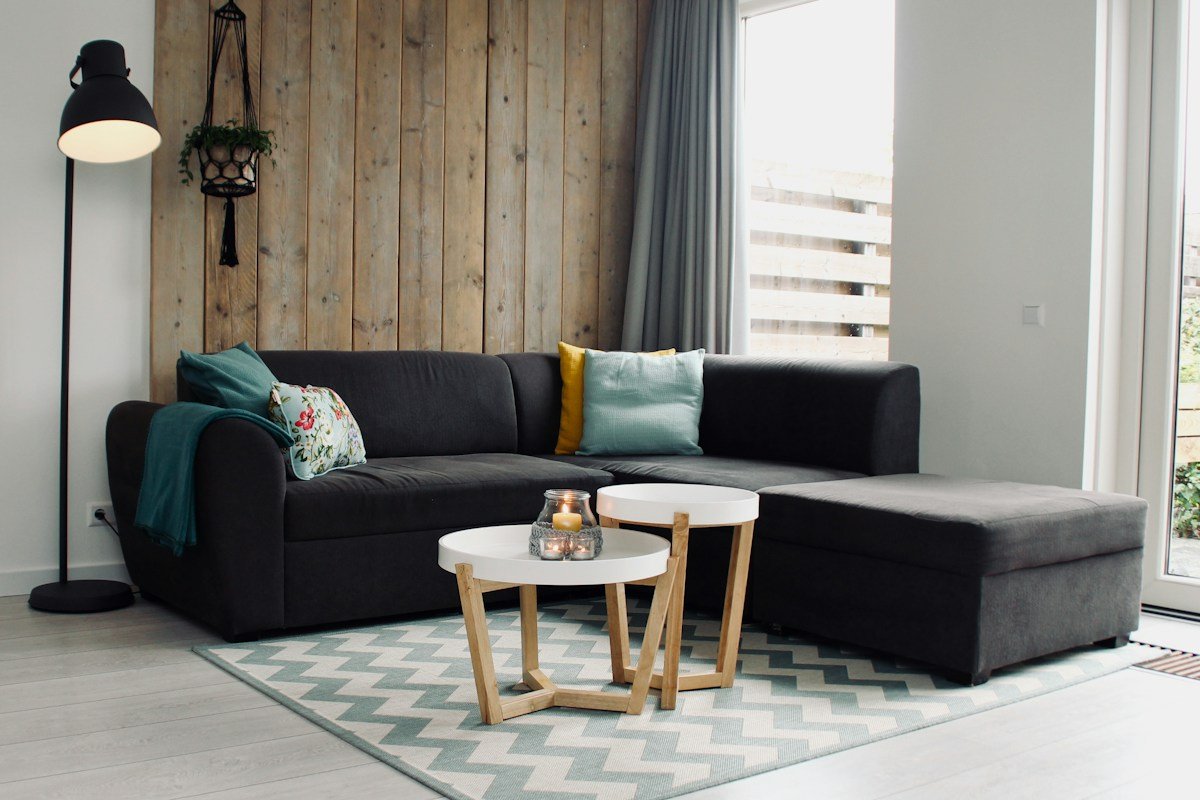
When applying the Front Legs Only layout to an L-shaped sectional sofa, the front legs of the entire sofa assembly: along both the main sofa back and the return wing: must rest uniformly on the rug. Furthermore, the rug must extend outward past the end of the projecting chaise lounge by at least twelve to eighteen inches! If the chaise terminates right at the edge of the rug or extends past it onto the hardwood, the visual balance is shattered, making the chaise look like an afterthought bolted onto the room.
For U-shaped sectionals, the entire inner conversational courtyard of the sofa must be fully carpeted by the rug. The rug must extend beneath the front legs of the central sofa bank and both flanking wings, creating a warm, enclosed textile basin for the coffee table and family gatherings.
The Perimeter Border Rule: Distance to Walls and Hardwood Exposure
An area rug should never be mistaken for wall-to-wall carpeting. The fundamental design magic of an area rug lies in contrast: framing the luxurious, textured wool textile with an exposed perimeter border of beautiful natural hardwood, stone, or architectural tile flooring. This frame of exposed flooring provides visual breathing room, highlights perimeter baseboard trim and crown mouldings, and prevents the living room from feeling visually congested.
Interior design standards dictate the Golden Perimeter Margin: a consistent frame of exposed flooring measuring twelve to eighteen inches should surround the area rug on all four sides relative to the room walls. In a standard fourteen-by-eighteen-foot living room, subtracting twelve to eighteen inches from all four perimeters dictates an ideal rug size of eleven-by-fifteen feet or twelve-by-sixteen feet.
In smaller, compact living rooms (under twelve by fourteen feet), this perimeter border can be safely reduced to eight to ten inches to maximize comfortable underfoot cushioning without suffocating the room. In cavernous, high-ceiling luxury great rooms (exceeding twenty by twenty-five feet), the perimeter margin can expand to twenty-four to thirty inches, allowing the natural grain of wide-plank white oak flooring to shine as a rich architectural border framing the central seating pavilion.
High-Traffic Pathways and Door Clearance Mechanics
Living rooms are dynamic transit hubs connecting entryways, dining halls, kitchens, and outdoor patio portals. A common, irritating functional flaw in amateur rug placement is ignoring the natural human walking pathways through the room.
When a rug boundary bisects a primary walking path, it creates the uncomfortable “limping pathway” problem: an occupant walking through the room is forced to travel with one foot on the plush wool rug and one foot down on the bare hardwood floor. This uneven walking surface creates physical awkwardness and significant tripping hazards for elderly guests and young children. As an absolute layout rule: primary walking pathways should either be entirely ON the rug or entirely OFF the rug! Either size the rug wide enough that the walking corridor sits fully on the wool pile, or size it down so that the path travels cleanly along bare hardwood.
Door clearance mechanics must be evaluated before finalizing rug thickness and placement. Measure the vertical clearance gap (undercut) beneath all interior swinging passage doors, closet doors, and exterior French patio doors that open into the living room. Standard interior doors feature an undercut clearance of 5/8 to 3/4 inch. If you place a heavy, high-pile Moroccan wool rug (1.0 to 1.5 inches thick) combined with a 3/8-inch rug pad in the path of a swinging door, the door will bind tightly and jam shut against the wool pile. Near door swings, specify low-profile flatweave kilims or hand-knotted low-pile wool rugs with total assembly thicknesses under half an inch.
Rug Pads and Floor Protection Engineering
Behind every exceptional area rug sits an indispensable, unseen structural component: the rug pad. Many homeowners view a rug pad as an optional accessory or an annoying upsell at checkout. In truth, installing a handwoven wool rug without an engineered rug pad is the fastest way to ruin both the rug and the expensive hardwood flooring beneath it.
Beware of cheap, open-mesh PVC plastic waffle pads commonly sold in hardware stores! These cheap plastic pads are manufactured using synthetic polyvinyl chloride plasticizers that degrade over time. Under the heat and pressure of daily foot traffic, the plasticizers migrate into the hardwood floor finish, chemically reacting with polyurethane and lacquer coatings to leave permanent, sticky honeycomb grid stains and yellow discoloration that can only be repaired by expensive floor sanding and refinishing.
The gold standard of rug pad engineering is a dual-surface, high-density felt and natural rubber pad (such as a 1/4-inch to 3/8-inch recycled wool/synthetic felt pad with an authentic natural rubber backing). The natural rubber side grips the hardwood floor firmly without any adhesive chemicals, completely eliminating rug slipping, creeping, and bunching. The dense felt top layer cushions the underside of the wool rug, absorbing the mechanical impact of footsteps and heavy furniture legs.
A quality rug pad extends the physical lifespan of a handwoven wool rug by up to fifty percent. When an unpadded rug is walked on over hard flooring, the wool knots on the underside are repeatedly ground against the unyielding wood subfloor, shearing internal fibers and causing premature wear. A dense felt pad acts as a shock absorber, protecting the structural warp and weft foundation of the rug from fiber abrasion.
Color, Pattern, and Visual Texture Orchestration
An area rug occupies the largest uninterrupted field of pattern and color in the living room, setting the emotional tone for the entire interior. Harmonizing the rug with surrounding upholstery, wall colors, and architectural finishes requires careful visual balancing.
If your living room seating features solid, neutral performance fabrics (such as an ivory linen sectional and tailored charcoal armchairs), the area rug provides a magnificent canvas for intricate pattern and rich historical color. Antique overdyed Persian rugs, geometric Caucasian tribal weaves, or complex Turkish Oushak designs inject vibrant soul, timeless depth, and artisanal heritage into the room. The multi-tonal motifs also provide fantastic practical camouflage, easily disguising minor daily dust and pet hair between vacuuming cycles.
Conversely, if your living room already features bold architectural elements: such as patterned accent wallpaper, colorful abstract wall art, or dramatically veined marble fireplace surrounds: an understated, highly textured neutral wool rug is the ideal grounding choice. Specify un-dyed natural wool rugs featuring rich tactile textures: such as chunky high-low loops, ribbed herringbone weaves, or subtle high-pile Moroccan Berber diamond lines. The natural variations in undyed sheep wool (ranging from soft cream and oatmeal to warm taupe and charcoal) introduce organic biophilic warmth without competing with surrounding design accents.
Long-Term Maintenance, Shedding Management, and Professional Conservation
Handwoven natural wool rugs are remarkably resilient, but they require informed stewardship to preserve their lanolin luster and structural integrity across decades of family life.
Understanding new wool shedding prevents unwarranted panic. Homeowners who purchase a brand-new wool rug are often alarmed when their vacuum cleaner canister fills with loose wool fibers during the first few months. This is entirely normal and is not a defect! During the hand-shearing process at the loom, short staple fiber ends settle into the pile. Over the first two to three months of foot traffic, these fibers rise to the surface. Once this initial shedding cycle completes, the rug stabilizes and shedding drops to near-zero.
Vacuuming technique is critical for protecting wool pile. Never use a high-powered rotating vacuum beater bar (brush roller) on a handwoven wool rug! The aggressive, motorized spinning bristles snag delicate wool loops, shred hand-tied knots, and cause extensive fiber fuzzing and premature pile degradation. Always disengage the rotating brush roller and use suction-only mode, or use a specialized smooth-gliding hard floor attachment. Furthermore, never vacuum directly over hand-tied fringe tassels; the spinning roller will suck in the fringe, tearing the structural warp threads and unraveling the rug end.
Spot cleaning spills requires gentle patience. Never rub or scrub a wet spill aggressively, as scrubbing forces liquid deep into the wool cortex and permanently mats the surface pile. Always blot immediately using clean, dry white cotton towels or unbleached paper towels, pressing firmly to absorb the liquid. If residue remains, sponge gently with cold water mixed with a few drops of mild wool-safe pH-neutral detergent, blotting continuously until clear. Never use harsh supermarket carpet spotters containing bleach, ammonia, or optical brighteners, which strip natural lanolin and permanently bleach organic vegetable dyes.
Rotate your area rug one hundred and eighty degrees once every twelve to eighteen months. Rotating the rug ensures that foot traffic wear patterns, furniture leg indentation, and natural window ultraviolet sunlight exposure are distributed evenly across the entire surface, preventing localized fading and extending the pristine appearance of your heirloom investment.
Area Rug Material and Construction Specification Analysis
The comparative analysis table below synthesizes key architectural performance metrics, construction typologies, knot/stitch densities, expected service lifespans, stain cleanability, shedding tendencies, and price tiers per standard eight-by-ten-foot rug across four primary categories: Hand-Knotted Natural Wool, Hand-Tufted Wool with Latex, Handwoven Flatweave Kilim, and Machine-Woven Synthetic Polypropylene.
| Rug Construction Typology | Structural Density & Knotting | Backing Material | Expected Service Life | Stain Resilience & Cleaning | Shedding Profile | Average Investment (8×10) |
|---|---|---|---|---|---|---|
| Hand-Knotted Natural Wool | 100 – 400+ KPSI (Individual knots) | None (Pure woven warp/weft) | 50 – 100+ Years (Heirloom) | Exceptional (Natural lanolin wax) | Low to moderate (First 8 weeks) | ,800 – ,500+ |
| Hand-Tufted Wool | Mechanically punched yarn loops | Latex glue & secondary canvas | 7 – 12 Years (Adhesive fails) | Moderate (Cannot soak clean) | Heavy (Continuous short fibers) | – |
| Handwoven Flatweave Kilim | Tightly interlocked pileless wefts | None (100% Reversible face) | 25 – 40 Years (With pad) | High (Spot cleans & flippable) | Near zero (Tightly spun) | – ,400 |
| Machine Synthetic (Polypropylene) | Power-loomed plastic filaments | Jute & synthetic melted mesh | 3 – 5 Years (Fibers crush flat) | Stains easily with oil/petroleum | Zero (Extruded plastic lines) | – |
Analyzing this comparative data clearly demonstrates why authentic hand-knotted natural wool rugs represent the premier architectural investment for residential living rooms. While synthetic machine-made polypropylene rugs offer tempting entry-level pricing, their petrochemical fibers suffer from irreversible crushing under furniture legs and oil-based staining that quickly leaves living rooms looking worn and tired within three to five years, requiring frequent landfill replacements.
Hand-knotted natural wool rugs occupy a class of their own: completely free of synthetic adhesives and backed by millions of hand-tied knots that withstand century-scale family use. Thanks to wool’s natural lanolin wax barrier and crimp spring-back elasticity, hand-knotted rugs repel liquid spills effortlessly, bounce back from furniture indentation, and gain antique character over decades of loving use.
For casual living areas, high-traffic family dens, and sunrooms, handwoven flatweave kilims provide an outstanding, versatile alternative. With their reversible faces, near-zero fiber shedding, and crisp geometric lines, kilims deliver authentic handmade warmth at an accessible investment tier. When paired with an engineered natural rubber and felt pad and anchored according to the golden placement rules detailed in this guide, your area rug becomes the grounding soul of your home.
Frequently Asked Questions
What is the most common mistake when buying a living room area rug?
The number one mistake is buying a rug that is far too small for the room (the “postage stamp” effect). Homeowners often purchase a 5×7 or 6×9-foot rug for a room that requires an 8×10 or 9×12-foot rug. An undersized rug leaves furniture floating unanchored, visually shrinks the room, and disrupts conversational cohesion. Always measure your seating arrangement footprint before purchasing.
Can I place an area rug over existing wall-to-wall carpet?
Yes, layering an area rug over wall-to-wall carpeting is a classic designer technique to define conversation zones and inject color into rental homes or carpeted apartments. However, you must install a specialized “carpet-to-carpet” rug pad (such as a dual-sided pad with a tacky non-slip silicone backing) to prevent the area rug from creeping, wrinkling, and bunching as people walk across it.
How far should a rug extend past the sides of a sofa?
In both the All Legs On and Front Legs Only layouts, the area rug should extend a minimum of six to eight inches (and ideally ten to fourteen inches) past each outer arm of the sofa. This extension visually anchors the sofa within the rug perimeter and ensures that guests sitting on the ends of the couch step down onto plush rug pile rather than bare floor.
Why is my new wool rug shedding so much and how do I stop it?
Shedding is completely normal for new wool rugs and is not a defect. During the manufacturing and shearing process, loose staple fiber ends are created. Over the first two to three months of foot traffic, these fibers rise to the surface. To manage shedding, vacuum gently twice a week using suction only (with the rotating beater bar turned OFF). Shedding will naturally taper off to near-zero after eight to twelve weeks.
What is the difference between a hand-knotted and a hand-tufted rug?
A hand-knotted rug is woven entirely by tying individual knots of wool yarn around warp threads by hand, containing zero glue or backing adhesives, lasting fifty to one hundred years. A hand-tufted rug uses a mechanical gun to punch wool loops into a canvas backing, which are then glued into place with liquid latex rubber. Hand-tufted rugs last only seven to twelve years before the latex degrades and crumbles into chalky dust.
Should I choose a light-colored or dark-colored wool rug for my living room?
Choose based on room size, lighting, and lifestyle. Light-colored rugs (ivory, oatmeal, sand) reflect light and visually enlarge compact living rooms, but require diligent maintenance in homes with active pets or toddlers. Dark or richly patterned rugs (terracotta, indigo, vintage Persian motifs) ground large open-concept spaces and easily camouflage daily dust and traffic patterns between cleanings.
How thick should my living room rug pad be?
For residential living rooms, a 1/4-inch to 3/8-inch thick dual-surface felt and natural rubber pad is ideal. It provides luxurious cushioning, protects hardwood floor finishes from scratching, prevents rug slipping, and absorbs sound. Avoid pads thicker than 1/2-inch, as excessive cushion can cause furniture legs to wobble and creates tripping ledges along rug edges.
How do I remove heavy furniture indentations from a wool area rug?
Wool has phenomenal natural crimp memory and recovers easily from furniture pressure. To remove an indentation, place an ice cube directly into the compressed divot and allow it to melt slowly overnight. The cold moisture swells the keratin protein fibers. Once dry, gently lift and fluff the wool pile with a dinner fork or spoon edge to restore its original upright loft.
How often should a handwoven wool area rug be professionally cleaned?
Handwoven wool rugs should be professionally cleaned every three to five years by a certified rug cleaning specialist utilizing traditional immersion washing. Never take an authentic wool rug to a standard dry cleaner or use steam-cleaning extraction machines, as excessive heat and harsh chemicals strip protective lanolin and damage natural vegetable dyes.
Architectural Verdict and Grounded Comfort for Generational Living
Selecting and positioning a handwoven wool area rug is the single most transformative design decision you will make for your living room. It is the architectural anchor that tethers furniture to the floor, silences distracting acoustic echoes, and introduces the honest, grounding beauty of natural fiber into the center of family life.
Executing this transformation with design authority requires honoring geometric discipline: banishing undersized postage-stamp rugs in favor of generous eight-by-ten or nine-by-twelve-foot scales, ensuring front legs rest solidly six to ten inches onto the pile, maintaining twelve to eighteen inches of exposed hardwood framing, and pairing your textile with a high-density natural rubber and felt cushion pad.
When chosen with craftsmanship discernment and positioned according to the golden placement rules detailed in this guide, your handwoven wool area rug will transcend transient decorating fads: standing as an enduring, generational foundation of tactile warmth, aesthetic dignity, and heartfelt hospitality that welcomes your family home for decades to come.