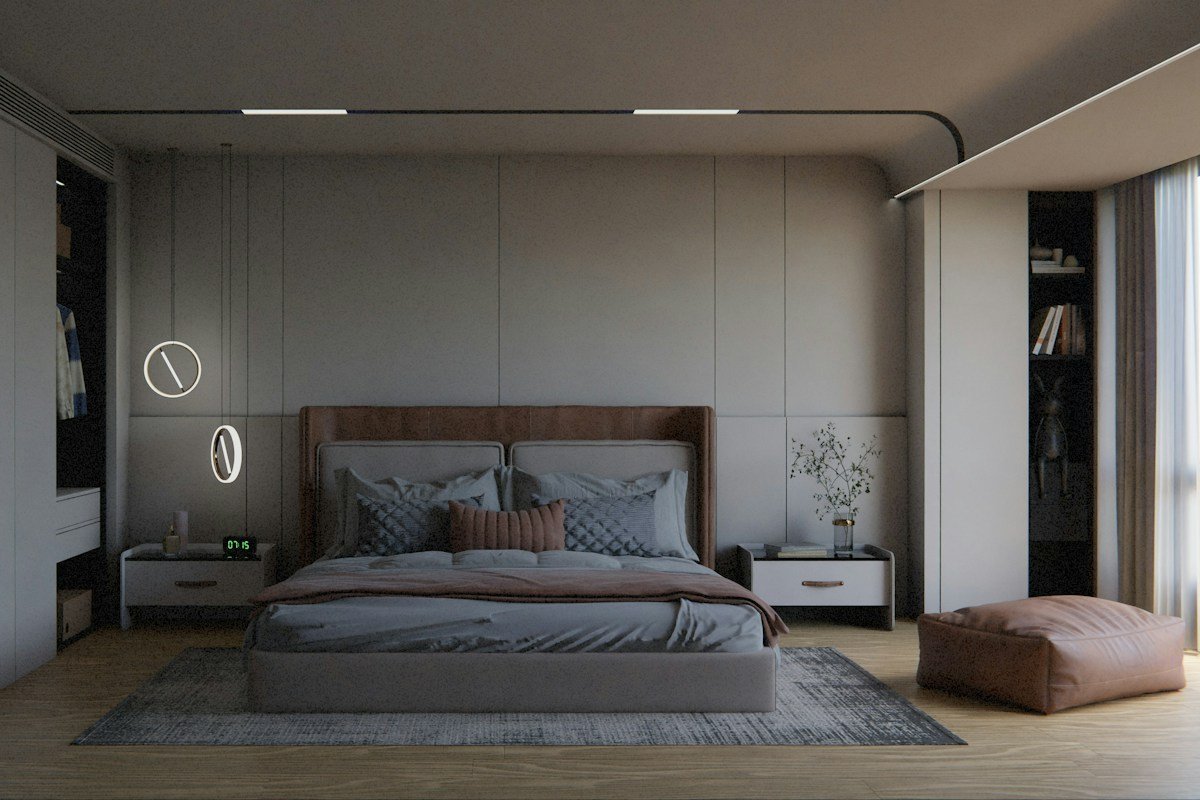
The master bedroom serves as the most sacred physiological and psychological sanctuary in the modern residence. It is the intimate chamber where we begin each morning and where we retreat each evening to shed daily stresses, recharge mental faculties, and surrender to restorative slow-wave sleep. In an era dominated by high-stress work schedules and ubiquitous digital screen exposure, the biological importance of a tranquil, circadian-supportive bedroom environment cannot be overstated. Yet in the vast majority of contemporary homes, bedroom lighting is treated as a thoughtless afterthought: subjected to generic builder-grade electrical layouts that violate basic human physiology and create uncomfortable, glaring living environments.
The most catastrophic and pervasive mistake in residential bedroom design is treating the sleeping chamber identically to a kitchen, laundry room, or commercial office: puncturing the ceiling with an arbitrary, symmetrical grid of high-lumen recessed downlights located directly over the bed. When an occupant lies back onto pillows to read, converse, or relax, their eyes are forced to stare directly upward into exposed high-intensity LED diodes. This direct optical glare triggers instant retinal discomfort, spikes neurochemical cortisol levels, and suppresses natural melatonin production, leaving occupants feeling restless, overstimulated, and unable to drift into peaceful slumber.
Designing an extraordinary bedroom ceiling lighting layout requires moving far beyond basic illumination into the nuanced science of human sleep hygiene, optical beam geometry, deep digital dimming, spectral power distribution, and perimeter spatial planning. Recessed ceiling pot lights can provide sleek, modern, clutter-free illumination across a master suite, but only when placed with surgical precision: establishing a strict “no-fly zone” above the mattress, grazing perimeter walls, washing wardrobe dressing zones, and utilizing warm-dimming solid-state LED diodes that replicate the calming amber wavelengths of setting sunsets.
Achieving this serene architectural balance requires synthesizing certified residential illumination standards from the Illuminating Engineering Society, neurological sleep research from the American Academy of Sleep Medicine, residential lighting fixture directives from the American Lighting Association, circadian health treatises from the National Sleep Foundation, and high-performance luminaire engineering from the International Association of Lighting Designers. This technical handbook delivers an authoritative, step-by-step blueprint for calculating lumens, spacing pot lights, selecting optics, and engineering deep-dimming controls for the modern bedroom.
Human Circadian Biology and Bedroom Photometry
To design bedroom lighting that supports physical wellness, one must first understand how light interacts with human neurobiology. The human eye contains specialized photoreceptors known as intrinsically photosensitive retinal ganglion cells (ipRGCs). These cells do not contribute to visual image formation; instead, they measure ambient light wavelengths and communicate directly with the suprachiasmatic nucleus (SCN): the master circadian clock in the human brain that governs the twenty-four-hour sleep-wake cycle.
The ipRGC photoreceptors contain a photopigment called melanopsin, which is extraordinarily sensitive to blue-cyan light wavelengths in the 460 to 480-nanometer spectral band: the exact wavelengths present in midday natural sunlight and cool-white artificial LED bulbs (4000K to 5000K). When exposed to blue-enriched light in the evening, the brain is tricked into believing it is midday, immediately halting the pineal gland’s secretion of melatonin: the essential hormone that induces drowsiness and regulates deep sleep architecture. Conversely, exposure to long-wave, warm amber light (under 2700K) with minimal blue content allows melatonin synthesis to proceed unhindered, preparing the central nervous system for restorative sleep.
Lighting scientists quantify this biological impact using Melanopic Equivalent Daylight Illuminance (mEDI) and the Circadian Stimulus (CS) metric developed by the Lighting Research Center at Rensselaer Polytechnic Institute. A Circadian Stimulus value exceeding 0.3 during morning hours promotes alertness, mood stability, and cognitive performance. However, during the two hours preceding sleep, the Circadian Stimulus must drop below 0.1 mEDI to permit natural melatonin onset. Standard ceiling downlights operating at 4000K or unshielded 3000K deliver a disruptive CS value exceeding 0.25, directly impairing sleep latency and suppressing rapid eye movement (REM) sleep cycles.
Photometric calculations in bedrooms must therefore respect these biological imperatives. While commercial workspaces demand fifty to eighty foot-candles, bedrooms require dramatically lower illumination levels. For general daytime cleaning, bed-making, and dressing, a bedroom requires an ambient baseline of only ten to twenty foot-candles (roughly 100 to 200 lux). In the late evening during pre-sleep wind-down routines, ambient illumination should drop to an ultra-soft two to five foot-candles (20 to 50 lux), accompanied by a dramatic shift toward warm color temperatures.
Calculating total lumen requirements for a master bedroom follows a simple mathematical formula based on room square footage: multiply the total square footage of the room by fifteen to twenty lumens. For example, a generous master bedroom measuring fourteen feet by sixteen feet encompasses two hundred and twenty-four square feet. Multiplying 224 square feet by fifteen lumens yields a target baseline of approximately 3,360 total lumens for the entire room. Distributing this output across six well-placed recessed fixtures yields roughly 550 to 600 lumens per pot light: an ideal, gentle output that provides ample brightness when needed while remaining effortless to dim down to whisper-soft levels at night.
The “No-Fly Zone”: Bed Perimeter Placement Physics
The single most important layout rule in bedroom lighting engineering is the establishment of the “No-Fly Zone.” The No-Fly Zone encompasses the entire physical footprint of the bed frame, headboard, side nightstands, and especially the pillow zone. Under no circumstances should a recessed downlight be positioned in the ceiling directly above the mattress plane!
Installing pot lights over a bed violates the fundamental principles of optical comfort. When a person is seated in bed reading or lying prone on a mattress, their field of view is oriented directly toward the ceiling. A ceiling light located overhead creates direct disability glare, shining concentrated light cones straight into the retina. Furthermore, an overhead fixture casts unflattering, harsh downward shadows across your partner face, turning a tranquil bedtime conversation into an interrogation room atmosphere.
To mathematically define the No-Fly Zone during electrical rough-in layout, carpenters and electricians must consult the planned furniture schedule. A standard Queen-size mattress measures sixty inches wide by eighty inches long (5 feet by 6.67 feet), while a King-size mattress measures seventy-six inches wide by eighty inches long (6.33 feet by 6.67 feet). Adding headboard depth and side nightstands (typically twenty-four to thirty inches wide each) establishes an absolute restricted zone measuring ten to eleven feet in width by eight to nine feet in projection from the headboard wall. No ceiling cans should ever penetrate this rectangular ceiling envelope.
Instead of clustering downlights above the bed, professional lighting designers push recessed pot lights out to the perimeter of the room, utilizing perimeter wall grazing and circulation path illumination. The primary purpose of bedroom recessed downlights is to illuminate architectural surfaces: perimeter walls, dressers, artwork, and closet doors: and to light the walking pathways around the bed.
The optimal layout geometry establishes two primary lighting lines parallel to the side walls of the room, positioned twenty-four to thirty inches away from the wall surfaces. Positioning pot lights twenty-four to thirty inches from a wall allows the downward light cone to graze gently down the vertical wall surface. This vertical wall washing creates a warm, diffuse ambient bounce that fills the entire bedroom with soft, indirect illumination without a single light beam shining into the eyes of someone resting in bed.
For the foot of the bed, pot lights should be positioned along the circulation corridor: typically two to three feet past the foot of the mattress, aligned with bedroom entryways and master bathroom access portals. This configuration ensures that late-night footsteps are safely illuminated while leaving the bed itself bathed in soothing, low-glare shadow.
Fixture Sizing and Aperture Engineering: Why 2-Inch and 3-Inch Micro-Apertures Reign Supreme
In luxury residential architecture, the visual aesthetic of the ceiling plane is just as critical as the light it produces. For decades, tract home builders installed bulky, five-inch and six-inch diameter recessed “can” lights across residential ceilings. These massive fixtures create visual clutter, turning a serene bedroom ceiling into a Swiss-cheese expanse of dark holes and plastic trim rings that scream utilitarian mediocrity.
Modern bedroom design has decisively embraced architectural micro-downlights: ultra-compact fixtures featuring two-inch, three-inch, or three-and-a-half-inch apertures. These miniature luminaires represent an extraordinary triumph of solid-state thermal and optical engineering: packing high-output, color-rendering LED engines into sleek, minimalist footprints that virtually disappear into the ceiling plane when turned off.
Aperture engineering and baffle depth dictate optical comfort. To prevent glare in a bedroom, micro-downlights must feature deep-regressed baffles. In a deep-regressed fixture, the LED diode and primary optic lens are physically recessed two to two-and-a-half inches up inside the ceiling housing, concealed behind a matte black, bronze, or soft white conical baffle. This recessed positioning creates a sharp forty-degree to forty-five-degree optical cut-off angle. When walking through the bedroom, the glowing light source remains completely shielded from direct sightlines until an occupant is standing directly beneath the fixture.
Homeowners can choose between two sophisticated trim styles: flanged micro-trims and trimless (plaster-in) mud rings. Flanged micro-downlights feature an ultra-thin, razor-sharp die-cast aluminum bezel measuring less than one-eighth of an inch in profile, painted to match the ceiling color for an understated, tailored finish. For the ultimate in modern architectural minimalism, trimless fixtures utilize perforated metal plaster screens that are mudded, taped, and sanded flush into the drywall ceiling before painting. Trimless fixtures emerge directly from the smooth drywall with zero visible rim or bezel: presenting pure, seamless geometric apertures that define contemporary luxury.
Beam Spread Geometry and Optical Diffusers
Selecting the correct optical beam angle is where amateur lighting purchases frequently fail. Recessed LED pot lights do not cast light in generic patterns; their light is focused and directed by precision-engineered internal total internal reflection (TIR) optical lenses or faceted specular reflectors. Specifying the wrong beam spread can transform a restful bedroom into a chaotic landscape of hot spots and dark scallops.
Beam spread angles are classified into four primary categories:
Narrow Spot (10 to 15 degrees): Concentrated, laser-like beams engineered for projecting light across twenty-foot ceilings or highlighting small tabletop sculptures. Narrow spot beams should never be utilized for general bedroom ambient lighting, as they create intense, blinding pinpoint hot spots on hardwood floors and furniture.
Narrow Flood (25 to 30 degrees): Moderately focused beams ideal for highlighting specific vertical features: such as an oversized abstract painting above a bedroom credenza or a textured upholstered bench at the foot of the bed. Narrow floods provide crisp edge definition without excessive side scatter.
Wide Flood (40 to 50 degrees): The undisputed workhorse beam angle for residential bedroom ambient and perimeter downlighting. A 40-degree beam spread delivers a generous, balanced cone of light that spreads smoothly across vertical walls and horizontal flooring, ensuring that adjacent fixture beams overlap harmoniously at thirty inches above floor level without creating harsh scallops or dark shadows.
Very Wide Flood (60 degrees and wider): Expansive, diffuse beams engineered for low eight-foot ceilings or wide closet dressing corridors. Wide flood beams soften beam borders, creating smooth, gradual light transitions that feel exceptionally gentle on resting eyes.
Integrating specialized optical accessories inside the fixture housing further enhances bedroom comfort. Incorporating a micro-prismatic Solite softening lens or a frosted diffusion lens smooths the perimeter beam cutoff, eliminating striations and creating a feathered, cloud-like pool of light. For bedrooms with sloped, vaulted, or cathedral ceilings, specify adjustable directional gimbals with thirty-degree tilt mechanisms. Directional gimbals allow installers to compensate for roof pitches, ensuring that light beams fire straight down perpendicular to the floor plane rather than angling sideways into resting eyes.
Spectral Power Distribution and Circadian LED Diode Engineering
Understanding the physics of LED light emission reveals why generic solid-state bulbs feel so harsh on the human eye. Standard white LEDs do not emit pure white light naturally; they are fundamentally blue semiconductor diodes (gallium nitride) coated with a yellow cerium-doped yttrium aluminum garnet (YAG) phosphor. When the blue light excites the phosphor, it produces a composite spectrum that appears white to the naked eye. However, when analyzed on a spectrometer, standard LEDs reveal a sharp, unnatural spectral spike at 450 nanometers: directly targeting the melanopic receptors that suppress sleep.
Advanced residential lighting design specifies next-generation full-spectrum and circadian-engineered LED emitters: such as violet-pumped LEDs (exemplified by Soraa Vivid and Seoul Semiconductor SunLike technology). Rather than utilizing a harsh blue pump, these advanced diodes utilize a near-ultraviolet or violet semiconductor core combined with a multi-phosphor blend. This architecture generates a smooth, continuous Spectral Power Distribution that mimics the natural solar spectrum, completely eliminating the aggressive blue spike while delivering extraordinary color rendering (CRI 97+, R9 > 90, and Rf/Rg color fidelity ratings above 95).
Under full-spectrum circadian illumination, bedroom textiles appear rich and tactile, fine art canvases reveal subtle pigment undertones, and natural wood furnishings radiate deep warmth. Crucially, when evening approaches, the absence of excessive blue wavelengths allows the human visual cortex and endocrine system to unwind naturally, ensuring that your lighting choices support rather than undermine restorative sleep quality.
Dimming Architecture: Deep Electronic Dimming vs Basic Phase Dimmers
A bedroom lighting system without high-performance dimming is an absolute failure. In a kitchen, lights may operate at eighty to one hundred percent brightness throughout the evening; in a bedroom, lights rarely operate above forty percent brightness after dusk! However, the quality of dimming varies radically across electrical hardware, and understanding dimming engineering is critical to prevent frustrating operational defects.
The fatal flaw of cheap, big-box hardware store dimmers is their inability to achieve deep low-end trim. Standard forward-phase (triac) dimmers typically cut off at ten to fifteen percent brightness. While ten percent might sound low, the human eye perceives light non-linearly: according to the physiological Stevens’ Power Law and the IES formula, a measured ten percent light output is perceived by the human eye as roughly thirty-two percent brightness! When waking up in a pitch-black bedroom at two in the morning, thirty-two percent perceived brightness feels like a blinding flash of daylight that shocks the nervous system.
True bedroom luxury mandates deep electronic low voltage (ELV) or digital dimming capable of smooth, continuous dimming down to 1% or 0.1% of measured light output (which the human eye perceives as a whisper-soft three to ten percent glow). Achieving this ultra-low threshold requires pairing high-performance LED drivers with advanced architectural dimmers, such as Lutron Maestro, Lutron Caseta Pro, or Lutron RadioRA3 systems.
Warm-Dimming (Dim-to-Warm) solid-state technology represents the gold standard for bedroom environments. Standard static LEDs maintain the exact same color temperature as they dim down: a static 3000K bulb simply becomes a dimmer, greyish 3000K light. Warm-dim LED modules, by contrast, incorporate dual arrays of phosphor-converted diodes governed by an internal microcontroller. At one hundred percent brightness, the pot light delivers a clean, refreshing 3000K white for morning dressing and cleaning; as you dim the switch downward toward one percent, the fixture seamlessly slides down the blackbody curve to a deep, golden 1800K candlelight amber. This amber glow mimics the setting sun and flickering hearth fire, providing a biological signal that encourages immediate physical relaxation.
Bedroom Functional Sub-Zones: Closets, Dressers, Vanities, and Bedside Reading
A comprehensive master bedroom lighting plan must address four distinct functional sub-zones that demand specialized photometric treatment: walk-in closets, dresser storage, vanity grooming stations, and bedside reading nooks.
Walk-in closet dressing suites require high-intensity, high-fidelity task lighting. Trying to select clothing under dim, yellow light makes it virtually impossible to distinguish dark navy blue trousers from black trousers or to spot subtle fabric stains. Closet lighting demands a minimum of thirty to forty foot-candles (300 to 400 lux) and an uncompromising Color Rendering Index of 95+ (with an R9 value exceeding 60) to reveal accurate fabric hues and textile textures.
Crucially, closet recessed lighting must strictly comply with national electrical safety fire codes (NFPA 70 / National Electrical Code Section 410.16). The NEC mandates specific minimum physical clearances between recessed luminaires and combustible closet storage shelving to prevent clothing from contacting hot fixtures: recessed LED luminaires with completely enclosed light sources must maintain a minimum clearance of six inches from the nearest point of storage space (twelve inches for older incandescent fixtures). Position closet pot lights along the center of walking aisles, aimed directly at garment hanging rods.
Dresser and full-length mirror zones require careful vertical illumination. If a single downlight is placed directly above a person standing in front of a mirror, it casts deep, unflattering shadows under eyebrows, nose, and chin, making personal grooming difficult. The correct technique is positioning pot lights eighteen to twenty-four inches back from the mirror, or pairing a downlight with vertical architectural wall sconces mounted on either side of the mirror at eye level (sixty to sixty-six inches above the floor). Flanking sconces provide soft horizontal cross-illumination that fills in facial shadows, creating a luminous, flattering reflection.
Bedside reading illumination should always be decoupled from the ceiling pot light circuit. Reading in bed requires focused, low-wattage task light directed squarely onto book pages or e-readers without illuminating the entire room or disturbing a sleeping partner. Install articulated swing-arm reading sconces mounted to the wall thirty to thirty-six inches above the mattress, or drop slender micro-pendants directly over nightstands, equipped with narrow thirty-degree beam optics and dedicated bedside dimmer switches.
Tray Ceilings, Coffered Beams, and Indirect Cove Integration
Architectural ceiling details: such as recessed tray ceilings, floating soffits, and coffered wood beams: provide magnificent opportunities to integrate indirect ambient lighting, transforming the ceiling into a luminous architectural sculpture.
In a tray ceiling configuration, the central section of the ceiling is recessed upward by six to twelve inches above the perimeter room boundary. Rather than pasting pot lights across the tray, the ultimate lighting move is installing an architectural LED cove lighting system along the perimeter lip of the tray. Concealed high-density linear LED tape (delivering 200 to 350 lumens per linear foot at 2400K or warm-dim) fires upward into the recessed ceiling plane. The ceiling tray acts as a giant diffuse reflector, bouncing soft, shadowless light downward across the room. Recessed pot lights can then be reserved for the outer perimeter border, spaced four to five feet apart to wash bedroom walls.
Coffered ceilings feature intersecting structural or decorative beams forming a geometric grid of recessed square or rectangular pockets (coffers). Coffered ceilings demand symmetrical discipline: each individual coffer should feature either a centered architectural micro-downlight or integrated perimeter cove moulding. Centering a sleek, three-inch deep-regressed pot light within each coffer creates a rhythmic, dignified ceiling pattern that celebrates the woodwork while delivering perfectly distributed ambient illumination.
Sloped and Vaulted Ceiling Engineering
Master suites located on upper floors or in custom residences frequently showcase dramatic sloped, cathedral, or scissors truss rooflines. Installing standard flat-ceiling recessed downlights into an angled ceiling plane introduces severe optical distortions: the light beams fire at an angle, striking opposing walls with harsh glare while leaving floor areas in shadow, all while exposing the bare LED diode directly to occupants looking across the room.
Conquering sloped ceiling illumination requires specialized architectural hardware: sloped-ceiling housings and adjustable accent gimbals. Sloped ceiling downlight housings (engineered for specific roof pitches ranging from 2:12 to 12:12) feature internally angled lamp brackets that keep the LED engine oriented perfectly plumb to the floor. For flexible framing, adjustable gimbal luminaires allow thirty to forty degrees of internal directional adjustment and full 360-degree rotation.
When positioning downlights across a vaulted cathedral ceiling, align fixtures parallel to the ridge line, maintaining equal distances from the perimeter knee walls. To prevent glare when looking toward the high gable peak, fit each sloped fixture with an internal angled snoot or wall-wash scoop trim that blocks sightlines into the fixture housing from the lower elevation of the bed.
Electrical Rough-In Layout, 3-Way Switching, and Bedside Controls
The physical electrical infrastructure of a master bedroom lighting plan dictates whether the system is an effortless joy to use or a daily frustration. Homeowners must never be forced to walk across a dark room to turn off lights before getting into bed, or stumble in the dark to find a switch when waking up in the middle of the night.
The foundation of bedroom control ergonomics is multi-location 3-way and 4-way switching: or modern wireless digital keypad communication. Every primary bedroom lighting circuit must be controllable from at least three physical locations: the main bedroom entry doorway, the left side of the bed headboard, and the right side of the bed headboard. Installing low-profile digital keypads (such as Lutron Pico remotes or hardwired architectural keypads) directly beside nightstands allows each partner to control the entire bedroom lighting scene without rising from bed.
Electrical circuit zoning must separate distinct lighting layers onto independent dimmer loads. A master suite should feature a minimum of three independent circuits:
Circuit 1: Perimeter Ambient Pot Lights. Controls the recessed ceiling downlights washing the perimeter walls and circulation paths.
Circuit 2: Indirect Cove / Tray Accent. Controls the concealed linear LED extrusions inside ceiling coves or beam pockets, providing soft, wind-down mood lighting.
Circuit 3: Closet / Dressing Task Lights. Operates the high-output, high-CRI task luminaires inside wardrobes and dressing areas.
Bedside reading sconces should operate on dedicated local switches positioned within arm’s reach on each side of the headboard, ensuring complete individual autonomy for reading without affecting room ambient levels.
Smart home automation elevates bedroom functionality through astronomical timeclock scheduling and occupancy intelligence. Installing subtle micro-motion sensors beneath the bed frame or bedside baseboards allows for an automated “Midnight Guide” feature: when an occupant swings their feet out of bed onto the floor between midnight and 6:00 AM, low-voltage linear LED tape concealed beneath the bed frame or along the baseboard illuminates automatically at an ultra-low two percent brightness (1800K amber). This provides gentle, indirect guidance to the bathroom without requiring any hands to touch a switch or shocking sleep-adapted retinas with ceiling light.
Long-Term Maintenance, Thermal IC-Rated Housings, and Airtight Sealing
Behind the finished drywall ceiling sits the unseen mechanical infrastructure that ensures fire safety, energy efficiency, and decades of reliable operation. When installing recessed pot lights into a bedroom ceiling beneath an unconditioned attic, choosing the correct housing specification is paramount.
Insulation Contact (IC) Rated housings are mandatory whenever ceiling insulation is present. Standard non-IC housings generate excessive internal heat and require a minimum three-inch clearance from all fiberglass or cellulose insulation to prevent fire hazards. In older homes, these voids create massive uninsulated thermal bypasses that freeze bedrooms in winter. Modern IC-rated recessed downlights feature engineered aluminum heat sinks that dissipate thermal energy safely, allowing blown-in attic insulation to be packed directly against and over the fixture housing without overheating.
Air-Tight (AT) certified housings (tested in accordance with ASTM E283) are equally vital for building envelope integrity. Unsealed recessed cans act as open chimneys, sucking heated or air-conditioned bedroom air up into the attic via the stack effect and depositing moisture on cold roof sheathing. Air-tight housings incorporate closed-cell silicone perimeter gaskets and sealed electrical junction boxes that eliminate air leakage, maintaining the building thermal boundary and preventing drafts.
Solid-state LED reliability ensures that properly engineered architectural pot lights provide an operational lifespan exceeding 50,000 hours. Operating at four hours per day, a quality LED fixture will deliver over thirty-four years of maintenance-free illumination! Always specify fixtures with field-replaceable LED light engines and modular drivers, allowing future upgrades without cutting drywall or disturbing finished ceilings.
Bedroom Lighting Fixture Specification and Performance Analysis
The comparative analysis table below synthesizes key architectural performance metrics, visual aperture impact, glare shielding cut-off angles, minimum dimming thresholds, circadian sleep hygiene compatibility, installation complexities, and fixture cost expectations across four primary downlighting options: Architectural Micro-Downlights (2″-3″ Deep Baffle), Standard Builder Cans (5″-6″ Shallow Trim), Linear Perimeter Cove LEDs, and Trimless Mud-In Architectural Fixtures.
| Downlight Specification | Aperture Visual Impact | Glare Cut-Off Angle | Minimum Dimming Level | Circadian Sleep Compatibility | Installation Complexity | Hardware Cost per Location |
|---|---|---|---|---|---|---|
| Architectural Micro-Downlight (2″-3″ Deep Baffle) | Minimalist & tailored | 40 – 45 Degrees (Deep regressed) | 0.1% – 1.0% (Warm-Dim) | Exceptional (1800K low end) | Standard remodel / new work | – |
| Standard Builder Can (5″-6″ Shallow Trim) | Cluttered & commercial | 10 – 20 Degrees (Exposed lens) | 10% – 15% (Triac phase) | Poor (Static 3000K+ glare) | Basic DIY snap-in | – |
| Linear Perimeter Cove LED System | Invisible source (Pure bounce) | Total 100% Shielding | 0.1% (PWM digital) | Outstanding (Zero direct view) | Carpentry millwork required | – per lin ft |
| Trimless Mud-In Architectural Downlight | Flawless monolithic luxury | 45 Degrees (Deep regressed) | 0.1% – 1.0% (Warm-Dim) | Exceptional (1800K low end) | Drywall tape & mud finish | – |
Interpreting this comparative data illustrates the vast chasm between commodity construction and high-performance architectural lighting design. While standard builder-grade five-inch and six-inch cans offer cheap initial hardware costs, their shallow optics, poor ten-to-fifteen percent dimming thresholds, and harsh direct glare make them fundamentally incompatible with healthy sleep hygiene and peaceful bedroom relaxation. Living under shallow, glaring downlights subjects occupants to chronic evening visual stress and circadian disruption.
Architectural micro-downlights (two-inch to three-inch apertures) equipped with deep regressed baffles and warm-dimming solid-state engines represent the pinnacle of modern bedroom downlighting. Delivering true forty-five-degree optical cutoff angles and smooth 0.1 to 1.0 percent dimming down to 1800K candlelight amber, these luminaires eliminate glare, preserve circadian melatonin rhythms, and maintain a quiet, sophisticated ceiling plane that complements luxury residential interiors.
For custom renovations and luxury master suites, combining trimless mud-in micro-downlights with perimeter indirect cove lighting delivers the ultimate dream bedroom environment. By washing ceiling planes in soft, indirect diffuse illumination while concealing downlight apertures seamlessly flush into drywall surfaces, homeowners achieve a whisper-quiet, serene aesthetic that feels like a five-star luxury hotel retreat: nurturing deep, restorative sleep night after night.
Frequently Asked Questions
How many recessed pot lights do I need in a 12×14 foot master bedroom?
A standard 12×14 foot bedroom encompasses 168 square feet, requiring roughly 2,500 to 3,300 total lumens for general ambient lighting. This is best achieved by installing four to six well-spaced 3-inch architectural micro-downlights delivering 500 to 600 lumens each. The fixtures should be arranged in two parallel perimeter rows along circulation paths, leaving the central bed area completely free of direct overhead downlights.
How far from the wall should bedroom pot lights be placed?
Bedroom recessed pot lights should be positioned twenty-four to thirty inches away from the wall. This distance allows the light cone to wash down the vertical wall surface smoothly without creating harsh, narrow scallops or intense hot spots, creating a warm, indirect ambient bounce that visually enlarges the room.
What is the best color temperature for bedroom recessed lighting?
The ideal color temperature for bedroom lighting is 2700K (warm white) or an advanced warm-dimming fixture that transitions from 3000K down to 1800K. 2700K emits warm, relaxing golden tones that mimic traditional incandescent lighting. Avoid cool white (4000K or 5000K) bulbs in bedrooms, as their heavy blue-spectrum content suppresses melatonin secretion and disrupts sleep.
Can I install recessed lights directly above my bed pillows for reading?
No, you should never place recessed pot lights directly above the bed or pillows. Direct downward light shines straight into your eyes when reclining, causing severe retinal glare and eye strain. Bedside reading light should always be provided by dedicated, adjustable wall-mounted reading sconces or low-wattage directed bedside lamps with local controls.
Why do my LED pot lights buzz or flicker when dimmed?
LED buzzing and flickering occur when there is an incompatibility between the LED driver and the wall dimmer switch. Standard old incandescent dimmers (forward-phase triac) chop the AC electrical wave in a manner that creates electrical harmonics inside LED drivers. Solving this requires installing an electronic low voltage (ELV / reverse-phase) dimmer or an LED-rated digital dimmer specifically tested and approved on the fixture manufacturer’s compatibility list.
What is the difference between IC-rated and non-IC-rated recessed lights?
IC stands for “Insulation Contact.” An IC-rated recessed fixture is engineered with thermal safeguards that allow building insulation (such as blown-in fiberglass or cellulose) to be packed directly over and against the housing without creating a fire hazard. Non-IC fixtures require a three-inch void from all insulation, which creates major thermal leaks in bedroom ceilings beneath unconditioned attics. Always specify IC-rated fixtures for top-floor bedrooms.
What is a trimless recessed light and is it difficult to install?
A trimless recessed downlight is a high-end architectural fixture that features a perforated metal or composite mud ring instead of an overlapping plastic or metal trim bezel. The mud ring is screwed to the drywall, covered with joint compound, and sanded smooth so the fixture rim is completely hidden beneath paint. While it requires professional drywall taping skills, the finished result is a flawless, frameless circular aperture that sits completely flush with the ceiling.
Should bedroom pot lights be on the same switch as the ceiling fan light?
No, bedroom pot lights and ceiling fans should always be wired on separate, independent electrical circuits. Having them on the same switch prevents you from using the fan without the lights or dimming the lights while running the fan at full speed. Furthermore, placing recessed pot lights too close to spinning fan blades causes an intolerable, dizzying strobe effect across the room.
How low should a bedroom dimmer be able to dim down?
A high-performance bedroom dimmer should be capable of dimming down to 1% or 0.1% of measured light output. Basic household dimmers that stop at 10% brightness feel excessively bright when your eyes are dark-adapted in the middle of the night. Deep 1% dimming provides a faint, candle-like glow that allows safe navigation without waking a sleeping partner.
Architectural Verdict and Restful Luminous Serenity
Designing a master bedroom ceiling lighting schema is an exercise in empathy and architectural restraint. Rather than imposing blunt, high-intensity illumination across an expansive ceiling, true design mastery honors the biological vulnerability of human rest: sculpting a quiet, low-glare ceiling plane that transitions seamlessly from energizing morning routines to tranquil nocturnal wind-downs.
Achieving this peaceful serenity demands adhering to rigorous building science and optical principles: establishing an absolute “no-fly zone” over the mattress, specifying compact two-inch or three-inch deep-regressed micro-downlights that shield direct glare, washing perimeter walls in warm vertical light, and investing in deep 0.1 to 1.0 percent warm-dimming controls that mirror the natural golden arc of the setting sun.
When detailed with craftsmanship and wired for intuitive bedside control, your bedroom lighting layout will do far more than brighten a room: it will elevate your daily quality of life, protect your restorative sleep cycles, and shelter you in an enduring, tranquil sanctuary that welcomes you into deep, restorative peace every night of your life.